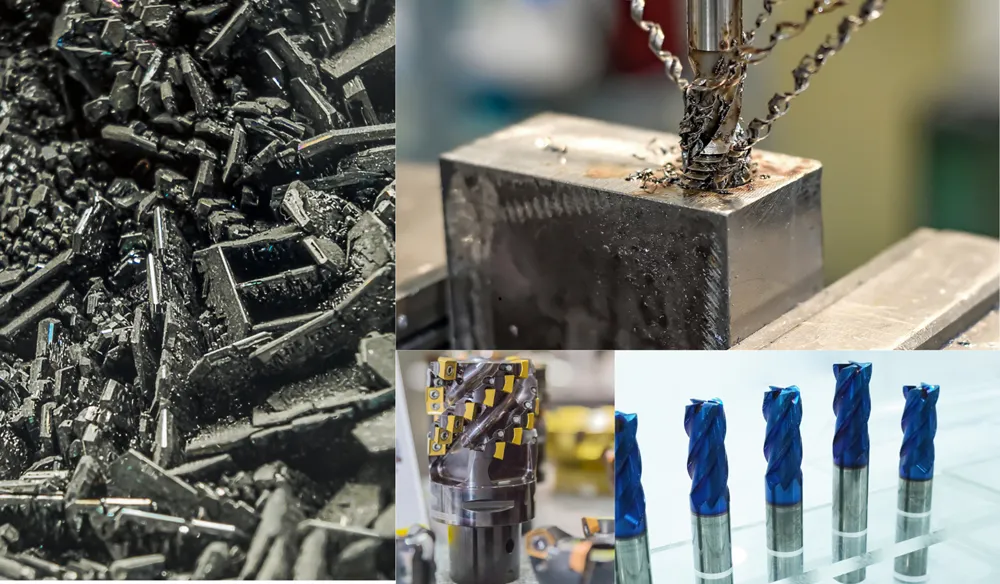
Often referred to as “the teeth of industry,” carbide has revolutionized machining, mining, and wear protection. But what exactly makes this material superior to traditional steel? Why is it the default choice for high-speed precision engineering?
If you are looking for answers, you are in the right place.
While High-Speed Steel (HSS) was once the standard, the demand for faster production cycles and harder materials pushed the limits of what steel could handle. Enter Tungsten Carbide—a composite material that combines the extreme hardness of tungsten with the toughness of cobalt. It delivers what engineers call “Red Hardness,” the ability to maintain a cutting edge even at temperatures where steel would turn soft as butter.
Whether you are a machinist looking to optimize tool life, a purchasing manager navigating complex ISO grade charts, or an engineer selecting materials for extreme wear environments, understanding carbide is essential.
In this comprehensive guide, we will break down everything you need to know about carbide:
The Science: What is it made of and how is it manufactured?
The Properties: Understanding Hardness (HRA) vs. Toughness (TRS).
The Selection: Decoding the ISO Grade Classification (P, M, K).
The Applications: From turning inserts to massive mining buttons.
Let’s dive into the microscopic world of the hardest metal composite known to man.
What is Carbide? The Science Behind the Material
To understand why Carbide (technically known as Cemented Carbide or Tungsten Carbide) performs so well, you first need to understand that it is not a “metal” in the traditional sense, like steel or iron. It is a Composite Material.
Much like fiberglass or carbon fiber, carbide derives its strength from combining two very different materials to create something superior to both. It is a product of Powder Metallurgy, created through a process of mixing, pressing, and sintering.
The Composition: A “Concrete” Analogy
The easiest way to understand the structure of carbide is to think of a concrete wall.
The Aggregate (Stones): In concrete, the stones provide the hardness and structural integrity. In carbide, this role is played by Tungsten Carbide (WC) particles. These are the “Hard Phase.” They are incredibly hard (close to diamond) and wear-resistant.
The Cement (Mortar): In concrete, the cement holds the stones together. In carbide, this is the Cobalt (Co). This is the “Binder Phase.” Cobalt is a softer, ductile metal that surrounds the tungsten particles, gluing them together and providing toughness.
Without the Cobalt binder, the Tungsten Carbide would be too brittle and would shatter like glass upon impact. Without the Tungsten Carbide, the Cobalt would be too soft to cut metal. Together, they form a material with the perfect balance of Hardness and Toughness.
Expert Note: While Tungsten and Cobalt are the main ingredients, manufacturers often add small amounts of other carbides like Titanium Carbide (TiC) or Tantalum Carbide (TaC). These additives improve the material’s resistance to heat and crater wear, specifically for steel cutting applications.
The Microstructure: Why Grain Size Matters
If you look at carbide under a high-powered microscope, you won’t see a uniform surface. You will see a landscape of angular grains (the WC) swimming in a river of metal (the Co).
This brings us to a critical concept in materials science: Grain Size.
The size of these Tungsten Carbide grains determines the final properties of the tool:
Fine Grains (Sub-micron / Nano): Think of these as fine sand. They pack together very tightly. This creates a harder, more wear-resistant edge, perfect for finishing operations or hard materials.
Coarse Grains: Think of these as large gravel. They have more cobalt between them. This makes the material tougher and more resistant to impact, ideal for mining buttons or heavy roughing cuts.
By manipulating the ratio of Cobalt (usually 6% to 25%) and the size of the WC Grains, engineers can tailor a specific Carbide Grade for any application.
Key Properties of Carbide: The Engineer’s Checklist
Why choose carbide over tool steel or ceramic? The answer lies in its unique combination of physical properties. However, for anyone selecting a carbide grade, there is one fundamental rule you must understand: The Trade-off.
The Hardness vs. Toughness Trade-off
In materials science, hardness and toughness are often enemies. Generally, as you make a material harder, it becomes more brittle (less tough). Carbide is no exception, but it manages this trade-off better than almost any other material.
Hardness (Wear Resistance): This is the material’s ability to resist scratching and wear.
Measured by: Rockwell A (HRA) or Vickers (HV). Unlike steel which uses Rockwell C (HRC), carbide is too hard for the C scale.
The Driver: Lower Cobalt content and finer WC grain sizes increase hardness.
Toughness (Transverse Rupture Strength – TRS): This is the material’s ability to resist breaking or chipping under impact.
Measured by: Applying a bending force until the sample snaps (PSI or N/mm²).
The Driver: Higher Cobalt content and coarser WC grain sizes increase toughness.
The Golden Rule:
Need to cut hard steel continuously? You need High Hardness (Low Cobalt, Fine Grain).
Need to drill into rock or handle interrupted cuts? You need High Toughness (High Cobalt, Coarse Grain).
Red Hardness: The “Secret Weapon”
If hardness is the shield, Red Hardness is the stamina.
When you cut metal at high speeds, friction generates intense heat—often exceeding 800°C (1472°F) at the cutting edge.
High-Speed Steel (HSS): At around 500°C, steel softens and loses its edge. It fails.
Carbide: Maintains its hardness and cutting edge at temperatures up to 1000°C.
This property, known as Hot Hardness or Red Hardness, allows carbide tools to run at cutting speeds 3 to 10 times faster than HSS tools. This directly translates to faster production cycles and lower costs per part.
Young’s Modulus (Stiffness) and Density
Two often-overlooked properties that set carbide apart:
Extreme Stiffness: Carbide has a Young’s Modulus approx. 2-3 times that of steel. This means a carbide boring bar will deflect (bend) much less than a steel bar, ensuring higher precision and better surface finish on the workpiece.
High Density: Carbide is heavy. Its density (around 14-15 g/cm³) is nearly double that of steel. This high density helps absorb vibration (chatter) during machining, further improving tool life.
Understanding Carbide Grades: The ISO Classification System
In the world of carbide, “One Size Fits All” is a recipe for disaster. A grade designed to cut soft aluminum will fail instantly if used on hardened steel.
To standardize this, the industry uses the ISO 513 Classification System. This system categorizes carbide grades based on the material they are designed to cut, using a universal color code and letter system.
Understanding this chart is the first step to selecting the right tool.
The “Big Three” Main Groups (P, M, K)
These three categories cover approximately 80% of all machining applications.
The Challenge: Steel produces long continuous chips. This creates immense heat and pressure on the tool face (Crater Wear).
The Solution: P-grade carbide typically has a higher content of Titanium Carbide (TiC) and Tantalum Carbide (TaC) for better heat resistance and crater wear protection.
Typical Application: High-speed turning and milling of steel components.
2. ISO M – Stainless Steel (Color: YELLOW)
Target Material: Austenitic, martensitic, and ferritic stainless steel.
The Challenge: Stainless steel is “sticky” and has high work-hardening tendencies. It generates heat and tends to build up on the cutting edge (Built-Up Edge or BUE).
The Solution: M-grade carbide requires a delicate balance. It needs to be tough enough to withstand the cutting forces but have a sharp positive edge to cut cleanly rather than “plow” through the material.
Typical Application: Food industry components, medical implants.
The Challenge: Cast iron produces short chips (dust-like). It is abrasive and often has a hard “skin” or sand inclusions from the casting process.
The Solution: K-grade carbide focuses on pure abrasive wear resistance. These grades usually have low Cobalt content and fine WC grain size for maximum hardness.
ISO N (Green): Non-ferrous metals (Aluminum, Copper, Brass). These grades are often uncoated and highly polished to prevent sticking.
ISO S (Brown): Heat Resistant Super Alloys (HRSA) like Inconel and Titanium. Used in aerospace; requires extreme heat resistance.
ISO H (Grey): Hardened Steel (45-65 HRC). Used as an alternative to grinding.
Decoding the Numbers: What does “P20” mean?
You will often see grades labeled as P10, P20, or P40. Here is the secret to reading these numbers:
Low Numbers (e.g., P05, P10):
Harder & More Wear Resistant.
Best for: Stable conditions, high cutting speeds, continuous cuts, finishing operations.
High Numbers (e.g., P40, P50):
Tougher & More Shock Resistant.
Best for: Unstable conditions, interrupted cuts, lower speeds, roughing operations.
Pro Tip: If you are roughing a steel forging with a heavy interrupted cut, choose a tough grade like P40. If you are doing a final high-speed finish pass on a smooth steel shaft, choose a hard grade like P10.
From Powder to Product: The Manufacturing Process
While the science is complex, the creation of a carbide tool can be broken down into four critical stages. Understanding this process helps in appreciating why high-quality carbide requires strict quality control.
1. Powder Preparation
It all starts with raw materials. Tungsten Carbide (WC) powder is mixed with Cobalt (Co) and other additives in a ball mill. This mixture, often called “Grade Powder,” creates a precise recipe.
Key Factor: The mixing must be perfectly uniform to avoid weak spots in the final product.
2. Pressing
The powder is pressed into a mold (die) to form the basic shape of the tool. At this stage, the material feels like a piece of chalk. It is called a “Green Compact”. It is very fragile and can be easily broken by hand.
3. Sintering – The Magic Moment
The green compact is placed in a furnace at temperatures near 1400°C (2550°F). Here, the Cobalt melts and acts as a liquid binder, pulling the Tungsten Carbide grains together.
The “Shrinkage” Fact: During sintering, the part shrinks by approximately 18-20% in linear dimension (or about 50% in volume). Ensuring the final product shrinks to the exact correct size is the true art of carbide manufacturing.
4. Grinding and Honing
Once cooled, the carbide is almost as hard as diamond. To achieve the final precise dimensions and sharp cutting edges, it must be ground using Industrial Diamond Wheels.
Carbide Coating Technologies: The “Skin” of the Tool
Walk into any machine shop, and you will see inserts that are gold, black, grey, or violet. These are not for decoration—they are advanced Coatings.
Today, over 80% of carbide tools are coated. Why? Because a coating acts as a thermal barrier, increases surface hardness, and reduces friction. It can increase tool life by 300% to 1000% compared to uncoated carbide.
There are two main technologies you must know: CVD and PVD.
CVD (Chemical Vapor Deposition) – The Heat Shield
Process: Created by chemical reactions inside a high-temperature reactor (700°C – 1050°C).
Characteristics:
Thicker coating (5 – 20 microns).
Extremely strong adhesion to the substrate.
Excellent heat resistance (thermal barrier).
Best Application:
Turning of steels and cast irons.
Roughing operations where heat and crater wear are the main enemies.
Note: Because the coating is thick, the cutting edge is slightly rounded (honed), making it less sharp but very strong.
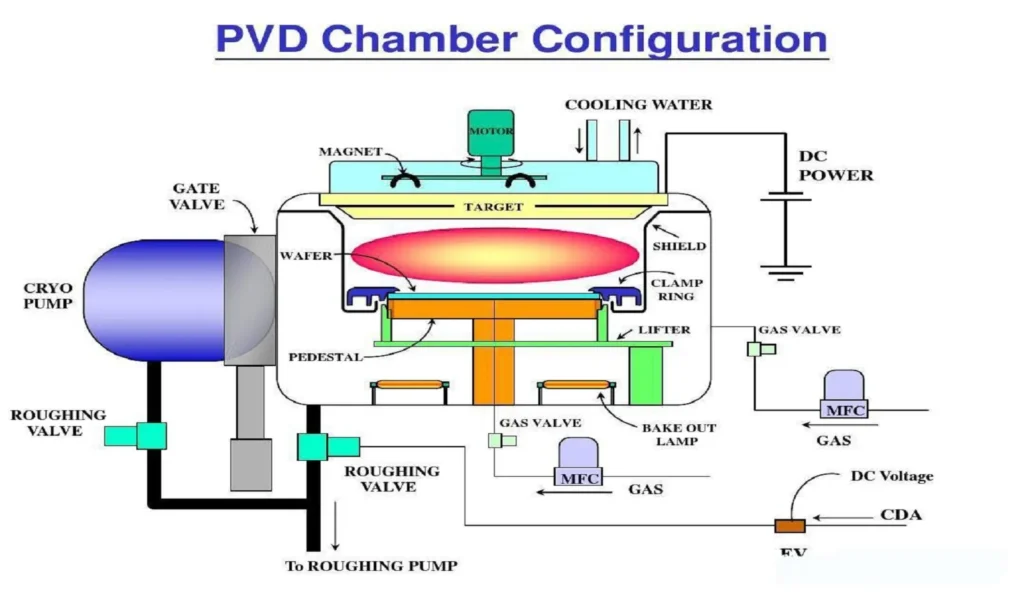
PVD (Physical Vapor Deposition) – The Sharp Protector
Process: Created by physical bombardment (evaporation or sputtering) in a vacuum at lower temperatures (400°C – 600°C).
Characteristics:
Thinner coating (1 – 5 microns).
Compressive stress adds toughness.
Allows for a sharper cutting edge.
Best Application:
Milling, Drilling, and Threading.
Finishing operations.
Difficult materials like Stainless Steel and Super Alloys, where a sharp edge is needed to prevent work hardening.
Decoding the Colors: Common Coating Materials
TiN (Titanium Nitride) – GOLD:
The classic general-purpose coating. Good lubricity and wear identification (you can easily see when it’s worn).
The modern standard. When heated, the Aluminum creates an aluminum oxide layer that reflects heat. Perfect for high-speed machining.
Al2O3 (Aluminum Oxide) – BLACK / GREY:
A ceramic coating often used in CVD. It is the ultimate heat shield, protecting the carbide substrate from high temperatures in steel turning.
Industrial Applications: Powering the Modern World
From the microscopic drill bit used by a dentist to the massive cutter head on a tunnel boring machine, carbide is ubiquitous. Its unique combination of wear resistance, heat tolerance, and compressive strength makes it the material of choice across three major sectors: Metal Cutting, Mining, and Wear Protection.
1. Metal Cutting Tools
This is the largest application sector, consuming over 50% of global carbide production. In the CNC machining world, carbide is the standard for precision and speed.
These are the small, replaceable “tips” clamped onto tool holders. They come in various shapes (CNMG, DNMG, APKT).
Why Carbide? It allows for cutting speeds 3-5 times faster than High-Speed Steel (HSS). When one edge wears out, the operator simply rotates (indexes) the insert to a fresh edge, maximizing machine uptime.
Solid Carbide End Mills:
Unlike inserts, these tools are ground from a solid carbide rod. They are critical for milling slots, pockets, and contours in aerospace and mold-making industries.
The Advantage: Their extreme rigidity (stiffness) minimizes deflection, allowing for high-precision tolerances and superior surface finishes on difficult materials like Titanium and Inconel.
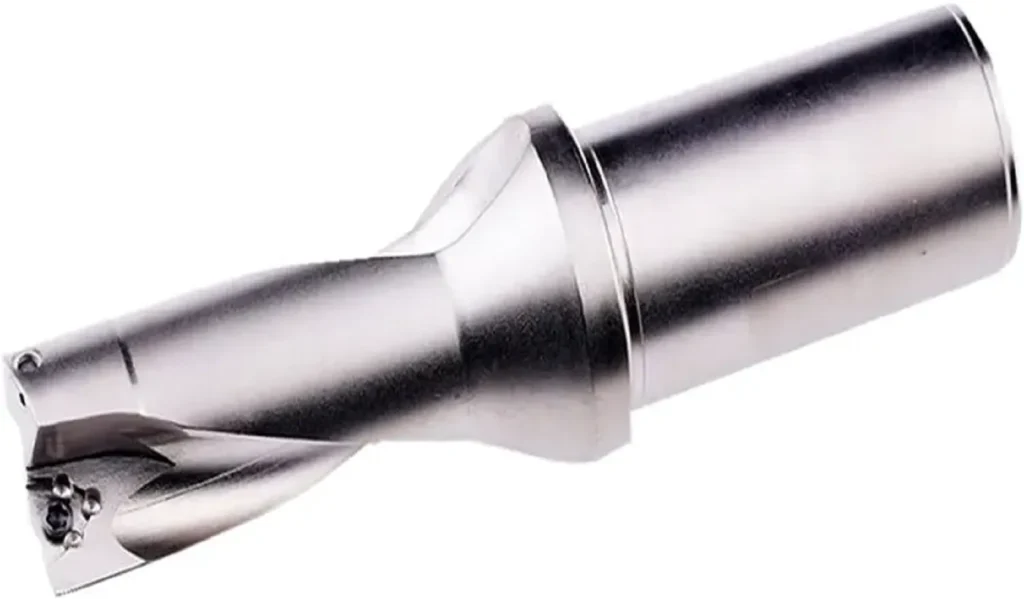
Drills:
Modern carbide drills often feature internal coolant holes (coolant-through).
Performance: They can penetrate steel at feed rates that would snap a traditional HSS drill instantly. The hardness of carbide maintains a sharp point longer, ensuring hole diameter accuracy over thousands of cycles.
2. Mining and Construction Tools
If metal cutting is about precision, this sector is about impact and brute force. Here, the “Toughness” of the carbide grade is paramount.
Drill Buttons:
These are the hemispherical or ballistic-shaped inserts pressed into heavy rock drilling bits (DTH bits, Top Hammer bits).
Application: They act as the “teeth” that crush rock in oil drilling, water well drilling, and mining. They must withstand high-frequency impact without shattering.
Shield Cutters for TBM :
Tunnel Boring Machines (TBMs) used for building subways and tunnels rely on massive carbide cutters.
The Challenge: These tools grind through mixed ground conditions—soil, sand, and hard granite. Carbide is the only material that offers the abrasion resistance needed to prevent frequent, costly tool changes underground.
3. Wear Parts
Carbide isn’t just for cutting; it’s also for resisting destruction. In many industries, carbide components are used simply because they don’t wear out.
Dies:
Cold Heading Dies: Used to stamp screws, bolts, and nuts. Carbide dies can produce millions of parts before losing dimensional tolerance, whereas steel dies might only last thousands.
Wire Drawing Dies: Used to pull copper or steel wire down to thinner diameters. The ultra-smooth, hard surface of carbide ensures the wire is not scratched.
Nozzles:
Used in sandblasting, waterjet cutting, and spray drying.
Why Carbide? When high-pressure abrasive particles (like sand or garnet) flow through a nozzle, they erode steel in minutes. A Boron Carbide or Tungsten Carbide nozzle can last for hundreds of hours.
Seal Rings:
Found in pumps and compressors in the Oil & Gas and Chemical industries.
Critical Role: These rings create a leak-proof seal between rotating shafts. They must survive in corrosive chemicals, high pressures, and abrasive slurries where other materials would fail.
Carbide vs. Other Materials: Making the Right Choice
In materials engineering, there is no “best” material—only the right material for the job. While carbide is the dominant force in modern manufacturing, understanding how it stacks up against its competitors is crucial for optimizing your production line.
Carbide vs. High-Speed Steel (HSS)
This is the classic debate. HSS has been around for over a century, but Carbide has largely replaced it in mass production. Here is the breakdown:
1. Speed and Heat (The Efficiency Factor):
Carbide: Can withstand temperatures up to 1000°C. This allows for cutting speeds 3 to 10 times faster than HSS.
HSS: Softens at around 500°C. It must run slower to keep cool.
Verdict: If you want to reduce cycle time and increase output, Carbide is the winner.
2. Toughness and Vibration:
HSS: It is incredibly tough. It can bend significantly before breaking and handles vibration well. This makes it ideal for older manual machines or unstable setups.
Carbide: It is rigid but brittle. If the machine vibrates or the tool crashes, carbide will snap or chip.
Verdict: Use HSS for manual machining or unstable conditions. Use Carbide for rigid, CNC machining.
3. Cost (Upfront vs. Long-term):
HSS: Cheap initial purchase price.
Carbide: More expensive upfront. However, because it lasts longer and cuts faster, the “Cost Per Part” is usually significantly lower with carbide.
Summary: HSS is the budget-friendly, tough choice for general maintenance and manual work. Carbide is the high-performance choice for production and profit.
Carbide vs. Cermet
Cermet (Ceramic + Metal) is often confused with Carbide, but they serve different roles. Cermet is typically composed of Titanium Carbonitride (TiCN) particles bonded with Nickel or Cobalt.
The “Mirror Finish” Advantage:
Cermet has extremely high chemical stability. Unlike carbide, it does not react with steel. This means the metal chips don’t stick to the tool (no Built-Up Edge), resulting in a shiny, mirror-like surface finish on the workpiece.
The Fragility Factor:
While harder and more chemically stable than standard carbide, Cermet is more brittle and has lower thermal shock resistance. It cannot handle heavy roughing or interrupted cuts as well as carbide.
Summary: Use Carbide for 90% of your operations (roughing, semi-finishing, and heavy cuts). Switch to Cermet only for the final high-speed finishing pass on steel to achieve a superior surface quality.
Recycling and Sustainability: The Green Cycle
Tungsten is a finite resource. Unlike iron or aluminum, it is relatively rare in the Earth’s crust. This makes Carbide Recycling not just an environmental choice, but a strategic and economic necessity.
Today, leading manufacturers estimate that over 50% of the tungsten used in new carbide tools comes from recycled scrap. But how do we turn a used, worn-out insert back into a brand-new tool?
The Zinc Reclamation Process
Unlike steel recycling, where scrap is simply melted down, carbide requires a more sophisticated approach to preserve its unique properties. The most common and energy-efficient method is the Zinc Process (PRZ – Porous Recycle Zinc).
Here is how it works:
Reaction: Scrap carbide is submerged in molten Zinc at roughly 900°C.
Expansion: The liquid Zinc reacts specifically with the Cobalt binder. It penetrates the material, causing the cobalt to expand. This expansion breaks the physical bonds holding the Tungsten Carbide (WC) grains together.
Distillation: The Zinc is then evaporated (vacuum distilled) and recovered for reuse.
Result: What remains is a loose, spongy powder of Tungsten Carbide and Cobalt.
The Key Advantage: This process does not change the chemical structure of the Tungsten Carbide grains. It returns the material to its original virgin quality, ready to be pressed and sintered into new tools again without any loss of performance.
Tungsten as a Strategic Resource
Tungsten is classified as a “Critical Raw Material” by both the EU and the US government.
Supply Chain Security: The vast majority of global tungsten reserves are concentrated in a few countries. Recycling provides a secure, domestic source of raw material, protecting manufacturers from geopolitical supply shocks or price volatility.
Energy Efficiency: producing tungsten powder from recycled scrap consumes 70% less energy and generates 40% less CO2 emissions than mining and refining tungsten ore (APT) from the ground.
Economic Value: For machine shops, used carbide is not trash—it is cash. The “Scrap Price” of carbide is significantly higher than steel. Implementing a recycling program can recover a substantial portion of tooling costs.
Pro Tip: Never throw used carbide inserts into the general metal bin. Segregate them. They are literally “heavy metal” gold.
Virgin vs. Recycled Carbide: Is There a Performance Drop?
For decades, there was a stigma in the machining industry that “recycled” meant “second-class.” Buyers often demanded “100% Virgin Material” for critical tools. However, modern metallurgy has changed the game.
To understand the pros and cons, we must distinguish between the two main recycling methods: Chemical Recycling and the Zinc Process.
1. The Reality of Performance
Chemically Recycled Carbide:
Process: The scrap is dissolved back into its atomic components (Tungsten, Carbon, Cobalt) and purified into Ammonium Paratungstate (APT).
Verdict: This material is indistinguishable from virgin ore. It has identical purity and grain structure. There is zero performance difference. It can be used for the most demanding aerospace applications.
Zinc Process (PRZ) Recycled Carbide:
Process: The cobalt binder is extracted, leaving the original Tungsten Carbide (WC) grains intact.
Verdict: The quality depends heavily on the sorting of the scrap. If you mix different grades (e.g., mixing steel-cutting grades with mining grades), the resulting powder will have trace contamination or inconsistent grain sizes.
2. Comparative Analysis: Pros and Cons
Here is how they stack up in practical metalworking applications:
Feature
Virgin Material
Recycled Material (Zinc Process / PRZ)
Purity & Consistency
High (Advantage). Exact control over grain size distribution and trace elements.
Variable. Depends on the purity of the scrap source. Slight trace elements (like Ta, Ti) from previous grades may remain.
Performance Limit
Unlimited. Essential for micro-drills (PCB), high-stress aerospace parts, and nano-grain grades (<0.5 microns).
Good to Excellent. Perfect for general turning, milling, and mining buttons. Performance is usually 90-99% of virgin.
Cost
High. Tied to global mining prices and geopolitical supply chains.
Lower (Advantage). Typically 15-30% cheaper to produce, offering stable pricing.
Energy Footprint
High. Mining and refining tungsten is energy-intensive.
Low (Advantage). Consumes ~70% less energy. Crucial for companies with “Green Procurement” targets.
General purpose machining, mining tools, wear parts, heavy roughing.
3. The Expert’s Verdict
When to insist on Virgin: If you are manufacturing micro-end mills (under 1mm), working with PCB drills, or producing aerospace components where failure is not an option, virgin material (or chemically recycled equivalent) provides the necessary grain-level consistency.
When to embrace Recycled: For general engineering, roughing inserts, mining buttons, and wear parts, modern recycled carbide (especially from reputable suppliers) offers virtually identical performance at a lower cost and a smaller carbon footprint.
Summary: The gap is closing. Today, a premium recycled grade often outperforms a budget virgin grade. It is not just about “New vs. Old”—it is about the quality of the powder metallurgy process.
FAQ
Does tungsten carbide rust?
Generally, no. Tungsten Carbide itself is extremely stable. However, the Cobalt binder can oxidize or corrode in the presence of strong acids or salt water. For corrosive environments (like chemical pumps), we recommend carbide grades using a Nickel binder instead of Cobalt, as Nickel offers superior corrosion resistance.
Is carbide magnetic?
Yes, usually. While Tungsten Carbide (WC) is non-magnetic, the Cobalt (Co) binder is ferromagnetic. Therefore, a standard magnet will stick to most carbide tools. However, the magnetic pull is weaker than on steel. “Non-magnetic carbide” exists but requires specialized binders like Nickel.
Can I sharpen carbide tools with a standard grinding wheel?
No. Carbide is harder than the aluminum oxide wheels found on standard bench grinders. Trying to grind it will just heat up the tool and wear down the wheel instantly. You must use Diamond Wheels (or Green Silicon Carbide wheels) to effectively grind or resharpen tungsten carbide.
What is the difference between “Tungsten” and “Tungsten Carbide”?
Tungsten is the pure metal element (Symbol: W), which has the highest melting point of all metals but is difficult to work with. Tungsten Carbide is a chemical compound (WC) mixed with a binder (like Cobalt) to create the usable, hard industrial material we use for tools. Think of Tungsten as the ingredient, and Tungsten Carbide as the finished cake.
Conclusion
From the micro-chip in your phone to the tunnel you drive through, Carbide makes modern life possible. It is not just a hard material; it is a solution to the eternal industrial demand for speed, precision, and longevity.
We have explored the science of its microstructure, decoded the colorful ISO grade charts, and analyzed the trade-offs between Virgin and Recycled materials.
Key Takeaways:
The Trade-off: Always balance Hardness (Wear Resistance) with Toughness (Shock Resistance).
The Speed: Carbide allows you to machine faster and hotter than HSS ever could.
The Grade: Choosing the right ISO grade (P, M, K) is critical—using a steel grade on aluminum will only lead to failure.
Ready to Optimize Your Production?
Choosing the right carbide grade can be the difference between a profitable job and a broken tool. Whether you need standard ISO Inserts, custom Wear Parts, or advice on Sustainable Tooling, our team of material experts is here to help.
Referance
1. Tungsten as a Strategic Resource (For Section 7: Sustainability)
What to cite: The fact that Tungsten is classified as a “Critical Raw Material” (CRM) by major governments.