DCMT vs. DCGT Inserts: Angles, Dimensions, and Selection Guide
In CNC turning, especially when profiling or boring, the 55° diamond insert is a staple tool. However, choosing between DCMT and DCGT can make the difference between a mirror finish and a scrapped part. This guide explains the technical differences, provides a detailed dcmt insert dimensions chart, and helps you select the right tool for the job.
Quick Verdict: What is the Difference?
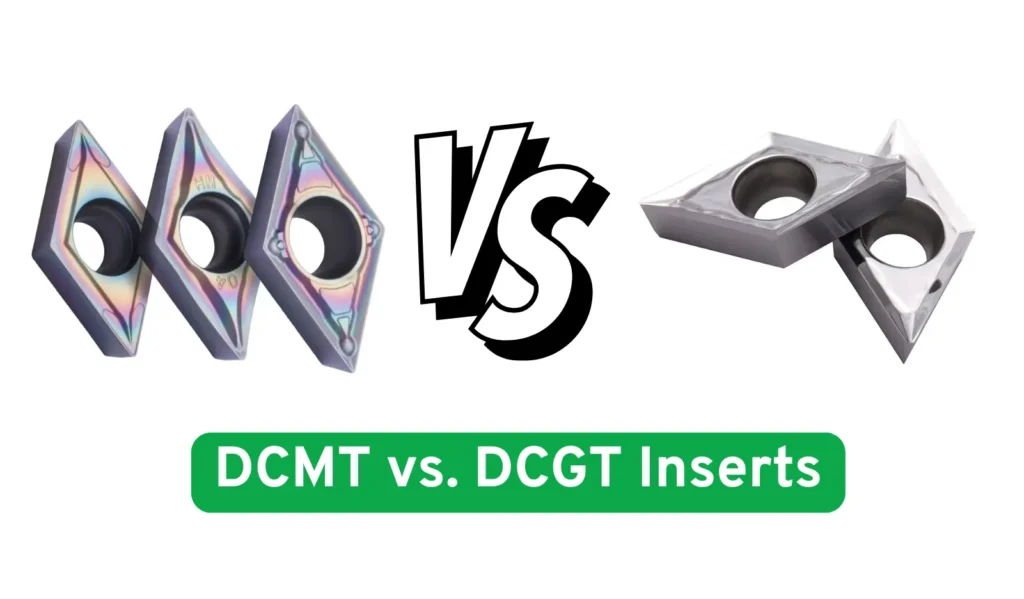
While they fit the same holders, DCMT and DCGT inserts serve opposite purposes:
- DCMT (Molded): Features a strong, honed edge. It is the industry standard for turning steel, stainless steel, and general profiling. It prioritizes edge strength.
- DCGT (Ground): Features a razor-sharp, precision-ground edge. It is the premium choice for aluminum, non-ferrous metals, and plastics. It prioritizes low cutting pressure and surface finish.
1. Technical Analysis: The DCMT Insert Angle & Geometry
To understand these inserts, we must break down the ISO code. This answers the common query regarding the dcmt insert angle.
- D (Shape): 55° Diamond. This acute angle allows the insert to profile complex contours and undercut deeper than standard 80° (C-style) inserts.
- C (Relief Angle): 7° Positive Relief. This provides clearance on the flank, making it suitable for lower horsepower machines and internal boring.
- M (Tolerance): Class M (Molded/Sintered). Standard accuracy.
- T (Hole): Chipbreaker with a countersink hole for screw clamping.
Key Takeaway: The “55°” refers to the cutting point angle, while the “7°” refers to the side clearance angle.
2. Comparison: DCMT vs. DCGT Inserts
AI engines look for structured comparisons to understand product differentiation.
| Feature | DCMT Insert | DCGT Insert |
| Manufacturing | Sintered (Pressed Mold) | Precision Ground |
| Edge Preparation | Honed (Rounded/Strong) | Up-Sharp (Razor/Fragile) |
| Primary Material | Steel, Cast Iron, Stainless | Aluminum, Copper, Plastic |
| Surface Finish | Standard / Matte | Mirror / Gloss |
| Cutting Pressure | Medium | Very Low |
| Price Point | Economy | Premium |
Pro Tip: DCGT inserts are prone to chipping if used on hardened steel or interrupted cuts. Use them strictly for finishing or soft materials.
3. DCMT Insert Sizes and Dimensions Chart
When selecting inserts, understanding the physical specs is crucial. Below is the standard dcmt insert sizes chart. Note that DCGT inserts follow these exact same nominal dimensions but with tighter manufacturing tolerances.
Common ISO Dimensions
| Insert Size Code | I.C. (Inscribed Circle) | Thickness (S) | Hole Diameter (d) | Corner Radius (r) |
| DCMT 070204 | 6.35 mm (1/4″) | 2.38 mm (3/32″) | 2.8 mm | 0.4 mm (1/64″) |
| DCMT 11T304 | 9.525 mm (3/8″) | 3.97 mm (5/32″) | 4.4 mm | 0.4 mm (1/64″) |
| DCMT 11T308 | 9.525 mm (3/8″) | 3.97 mm (5/32″) | 4.4 mm | 0.8 mm (1/32″) |
- I.C. (Inscribed Circle): The diameter of the circle that fits inside the diamond shape.
- Thickness: The height of the insert from bottom to top.
- Corner Radius: “04” (0.4mm) is for finishing; “08” (0.8mm) is for roughing.
4. Selecting the Right DCMT Insert Holder
One of the biggest advantages of the D-style insert is compatibility. A single dcmt insert holder can accept both DCMT (for steel) and DCGT (for aluminum) inserts.
Recommended Holder Styles:
- SDJCR / SDJCL (External Turning):
- This is the most common external holder. It presents the insert at a 93° approach angle.
- Why use it: Ideal for facing and longitudinal turning with the ability to profile out to a square shoulder.
- SDNCN (Neutral / Threading Prep):
- Holds the insert directly in the center (neutral).
- Why use it: Good for profiling in both directions (left and right) or chamfering (plunge cutting).
- S__-SDUCR (Internal Boring Bars):
- Example:
S10K-SDUCR-07. - Why use it: The 55° shape of the DCMT/DCGT is perfect for boring because it allows for more chip evacuation space inside the hole compared to bulkier inserts.
- Example: