Solid Carbide Ball Nose End Mills
Explore 2-flute ball nose end mills for 3D contouring, curved surface machining, mold and die work, and CNC profile finishing.
Compare ten product families for different workpiece materials, with standard, long and extra-long tool options.
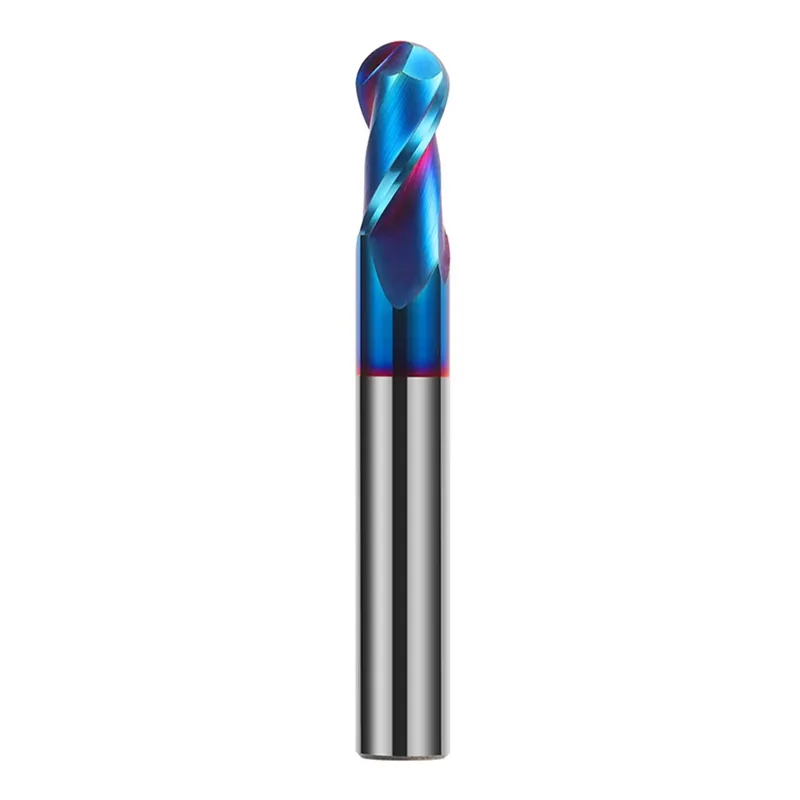
Ball Nose End Mill Applications
Rounded cutting tips follow complex 3D toolpaths and help machine transitions that cannot be produced efficiently with a sharp square end.
3D Contouring
Machining sculptured surfaces and blended profiles with ball-end toolpaths.
Mold & Die Work
Profiling cavity walls, mold cores and complex curved features.
Surface Finishing
Semi-finishing and finishing shaped surfaces when suitable stepover and cutting conditions are used.
Deep-Feature Access
Selecting longer tools for recessed features while checking overhang and machine stability.
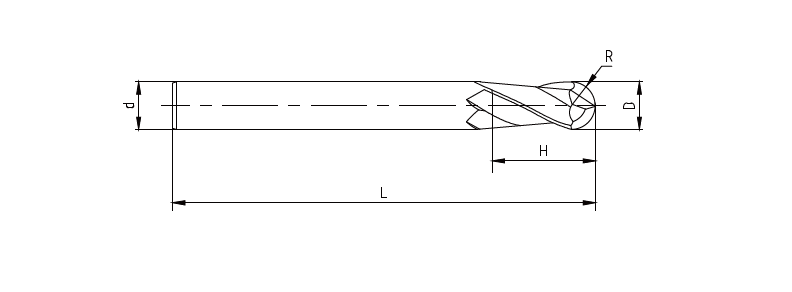
Ball Nose End Mill Dimensions
Use these measurements when comparing ball end mill sizes or submitting a specific order-number request.
For a standard full ball nose profile, R = D/2. Cutting length (H) and overall length (L) are not the same as guaranteed machining depth or usable reach.
Choose from 10 Carbide Ball Nose End Mill Families
Compare standard 2B models and their 2BL / 2BX length versions by workpiece material. Ask for specifications by series and tool dimensions.
All listed families use a 2-flute ball-end geometry. Choose a material group to narrow the selection.
Economical · Steel / Aluminum
Economical option for steel and aluminum machining; confirm finish and application conditions.
High Performance · Steel / Stainless
Performance-oriented selection for steels and stainless steels.
General-Purpose Machining
Carbon and alloy steels, stainless steel, cast iron, and hardened steel below HRC 40.
High Efficiency · Stainless / Titanium
For stainless steel and titanium-alloy applications.
High Efficiency · Steel / Stainless
For steel and stainless-steel contouring and finishing.
High-Speed / High-Hardness
For higher-hardness machining; confirm actual material hardness and finishing conditions.
High-Temp Alloys / Titanium
For titanium and heat-resistant alloys, with cutting conditions checked by grade.
Super-High-Hardness
For very hard materials; select by verified grade and actual hardness.
Economical · Aluminum
Economical ball nose option for aluminum 3D profiles and curved features.
High Performance · Aluminum
High-performance ball nose option for aluminum mold profiles and finishing.
Find a Ball Nose End Mill by Material
Select the series direction based on your workpiece grade, hardness, toolpath and finish requirements. Verify the actual model and coating before ordering.
Aluminum Alloys
HAL · HASDedicated aluminum ball nose families for curved surface machining and finishing.
Aluminum Tool Selection →Carbon & Alloy Steels
HMQ · HMP · HMM · HMVSelect tool geometry and length based on steel grade, machine setup and removal/finishing passes.
Compare Tool Geometry →Stainless Steel
HMP · HMM · HMT · HMVMatch the series to stainless grade, cutting temperature and toolpath stability.
Stainless Tool Selection →Cast Iron & General Steels
HMMGeneral-purpose milling of carbon and alloy steels, cast iron, stainless steel and hardened steel below HRC 40.
Ask About HMM-2B →Hardened Steels
HMH · HMXReview hardness, cutting conditions and requirements for molded or heat-treated parts.
Hard-Milling Selection →Titanium & High-Temp Alloys
HMT · HMSChoose models for difficult-to-machine alloys after confirming grade and cooling strategy.
Request Alloy Tool Advice →How Ball Radius and Stepover Affect Surface Finish
Ball nose end mills are widely used for 3D milling because the rounded tip can follow sculptured contours. For a standard full ball-end cutter, the ball radius is half of the nominal cutting diameter.
During finishing, adjacent toolpaths leave a small geometric cusp or scallop. A smaller stepover generally reduces the ideal scallop height, but may increase machining time.
h = theoretical scallop height; R = ball radius; s = lateral stepover. This relation is an ideal geometric model, not a guaranteed Ra value or a universal cutting recommendation.
Standard, Long and Extra-Long Ball Nose End Mills
Use the 2B, 2BL and 2BX variants to compare the available length options within a given series. Choose reach based on the toolpath and setup, not overall length alone.
Standard Length
A starting point for routine 3D contours and accessible surfaces where shorter projection may support greater rigidity.
Long Length
Extended length choices for deeper features and contouring; verify actual cutting length and required projection.
Extra-Long Length
Longer reach configurations for restricted access. Check vibration, holder clearance and allowable cutting conditions.
Request Ball Nose End Mill Pricing & Specifications
Share your workpiece, toolpath and ball nose cutter requirements so the most suitable family and dimensions can be reviewed.
- Product family or complete order number
- Cutting diameter D, shank diameter d and radius R
- Cutting length H, overall length L and required reach
- Material grade, hardness, quantity and any drawing
Request Pricing & Specifications
Include model, machining material and quantity where available.