Metallgewinde-Bearbeitungstechnologie - ein ausführlicher Leitfaden
Als Anbieter von Zerspanungswerkzeugen, der auf Überseemärkte abzielt, haben wir diesen Artikel optimiert, um uns auf internationale Normen, globale Trends und Fallstudien zu konzentrieren, die für Regionen wie Nordamerika, Europa und den Nahen Osten relevant sind. Wir haben den Schwerpunkt auf ISO-, ASME- und API-Normen gelegt und weltweite Marktdaten (z. B. die globale Gewindeschneidwerkzeuge Der Markt wird von 2026 bis 2033 mit einer CAGR von 7,2% wachsen, wobei das Hauptwachstum im Öl- und Gassektor sowie im Automobilsektor liegt. Außerdem werden Anbieter wie Sandvik, Kennametal und Cole Carbide hervorgehoben. Dies gewährleistet die Relevanz für internationale Ingenieure, Maschinenbauer und Beschaffungsteams im Bereich der Schneidwerkzeuganwendungen. Die Struktur bleibt leserfreundlich, mit erweiterten Erklärungen, Berechnungen, Schritt-für-Schritt-Anleitungen, Abbildungen und interaktiven Elementen wie Key Takeaways und Q&A für ein besseres Verständnis.
Einleitung: Die strategische Rolle der Gewindeherstellung in der globalen Metallproduktion
Gewindeschneiden ist ein grundlegender Prozess in der Metallbearbeitung, der für die Befestigung, Kraftübertragung und Hochdruckabdichtung in verschiedenen Branchen unerlässlich ist. Weltweit werden mehr als 60% mechanischer Komponenten mit Gewinden versehen. Der Markt für Gewindeschneidwerkzeuge wird 2025 auf Milliarden geschätzt und soll von 2026 bis 2033 mit einer CAGR von 7,2% wachsen, angetrieben von der Öl- und Gasindustrie, der Automobilindustrie und der Luft- und Raumfahrt in Nordamerika und Europa. Auf Schlüsselregionen wie die USA und die EU entfallen erhebliche Anteile, während der asiatisch-pazifische Raum rasch wächst.
Warum ist das Gewindeschneiden so wichtig? Es wirkt sich auf die Produktzuverlässigkeit, die Sicherheit und die Kosten aus. Bei einem Zwischenfall auf einer Ölbohrinsel in der Nordsee im Jahr 2020 kam es beispielsweise zu einem API-Gewindeversagen, das zu Leckagen und Verlusten in Höhe von über $10 Millionen führte; bei der Präzisionsbearbeitung kann ein Steigungsfehler der Getriebespindel von 0,05 mm die Genauigkeit von ±0,01 mm auf ±0,05 mm verschlechtern, was zu hohen Ausschussraten führt.
Dieses Handbuch bietet einen Überblick von den Grundlagen bis zur Meisterschaft, einschließlich Formeln, Optimierungswerkzeugen und Fehlersuchbäumen. Es ist ideal für Lieferanten und Anwender von Schneidwerkzeugen in Übersee und zielt darauf ab, die Ausschussrate um 30% zu senken und die Effizienz um 25% durch praktische Erkenntnisse zu steigern.
Wichtigste Erkenntnis: Gewindemängel sind oft auf eine schlechte Auswahl oder Bearbeitung zurückzuführen; eine frühzeitige globale Standardoptimierung spart erhebliche Kosten.
Umfassende Klassifizierung von Gewindetypen und Auswahlhilfe
Die Gewinde sind für eine einfache globale Anwendung nach Funktion und Profil kategorisiert. Lassen Sie uns Schritt für Schritt vorgehen:
Allzweckgewinde (Befestigung): 60° Flankenwinkel. ISO Metrisch (z.B. M6×1, Außendurchmesser 6mm, Teilung 1mm), grob für allgemeine Montage (M10×1,5), fein für vibrationsgefährdete Bereiche (M10×1,25). Unified Inch UN (UNC grob wie 1/4-20UNC, UNF fein). Rohrgewinde: BSPT (British Standard Pipe Taper, konisch selbstdichtend), NPT (National Pipe Thread, US-Norm, 1:16 konisch).Beispiel: Für Fahrgestellschrauben in der Automobilindustrie werden häufig grob gerollte ISO-Gewinde verwendet, um hohe Festigkeit und niedrige Kosten zu erzielen.
Übertragungsgewinde (Leistungsübertragung): Schwerpunkt auf Effizienz und Belastung. Trapezförmiger ACME (29° Winkel, Wirkungsgrad 80-90%), Formel: Wirkungsgrad η = tan(α/2) / (tan(α/2) + f), α=29°, f=Reibung 0,1-0,15. Strebepfeiler (3° Lastfläche, unidirektionale schwere Lasten wie Wagenheber); Vierkant (höchster Wirkungsgrad >95%, aber geringere Festigkeit); Kugelumlaufspindeln (Rollreibung, Wirkungsgrad >90%, einstellbares Spiel bis 0).Beispiel: CNC-Maschine Z-Achsen verwenden ACME 1-1/2×0,25, Axialkraft F = T / (η * P / 2π), T=Drehmoment, P=Steigung.
Öl- und Gasgewinde (Hochdruck-Dichtungen): Dichtheit und Drehmomentfestigkeit haben Vorrang. API Round (STC short round, LTC long round, BTC buttress with torque shoulder); Buttress (trapezförmiges Profil); Premium-Verbindungen (z.B. VAM TOP, Tenaris Hydril, Metall-Metall-Dichtung + Drehmomentschulter, CAL IV für >100MPa Druck, 1000 Zyklen leckfrei).Beispiel: Tiefseeschlauch verwendet BTC, Dichtungsmoment M = F * r * μ, F=Vorspannung, r=Schulterradius, μ=0,15.
Spezialgewinde: Multi-Start (2-4 Starts für Geschwindigkeit, z.B. Höhenruder); Variable Steigung (Anti-Lockerung); Links/Rechts-Verbund (selbstsichernd); Mikrogewinde (unter M1 für medizinische Implantate, IT3-Toleranz); Aerospace Hi-Lok (integrierter Sicherungsring).
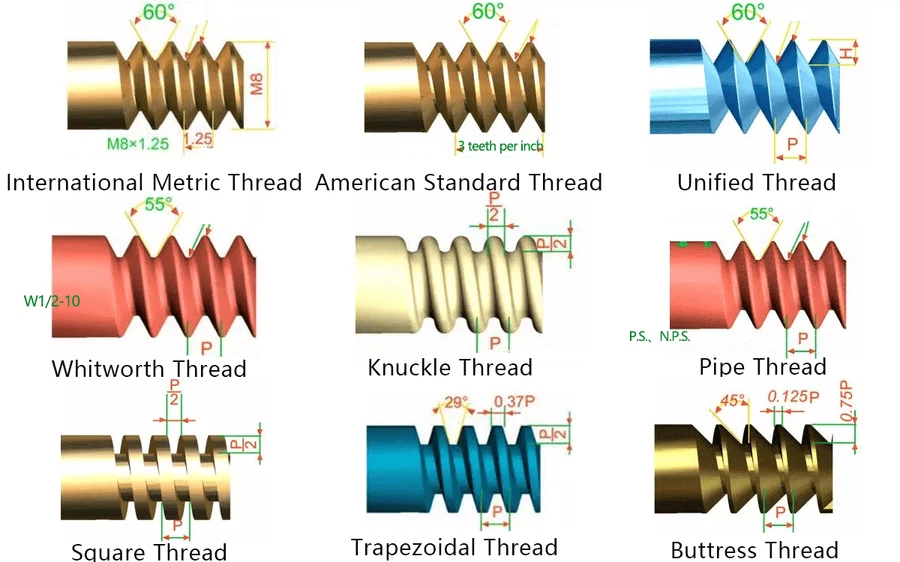
Erweiterte Auswahl-Vergleichstabelle (Mit Berechnungsbeispielen):
| Anmeldung | Lasttyp | Empfohlenes Thema | Wichtige Gründe | Auswahl Berechnungsbeispiel |
|---|---|---|---|---|
| Allgemeine Befestigungen | Zugfestigkeit | ISO Grob gewalzt | Geringe Kosten, hohe Festigkeit | M10×1,5, Spannung σ = F/(πd²/4) > 800MPa |
| Schweres Getriebe | Unidirektionale Schubkraft | Strebepfeiler/ACME | Große Auflagefläche | ACME 1×0,2, Wirkungsgrad η≈85% |
| Ölfeldrohre | Hochdruck-Dichtung | Premium-Anschluss | Gasdicht + drehmomentbeständig | BTC 5-1/2″, Drehmoment 8000Nm |
| Präzisionsmaschinen | Bidirektional | Kugelumlaufspindel | Hoher Wirkungsgrad, geringes Verdrehspiel | Umkehrspiel Δ=0,005mm, Genauigkeit ±0,01mm |
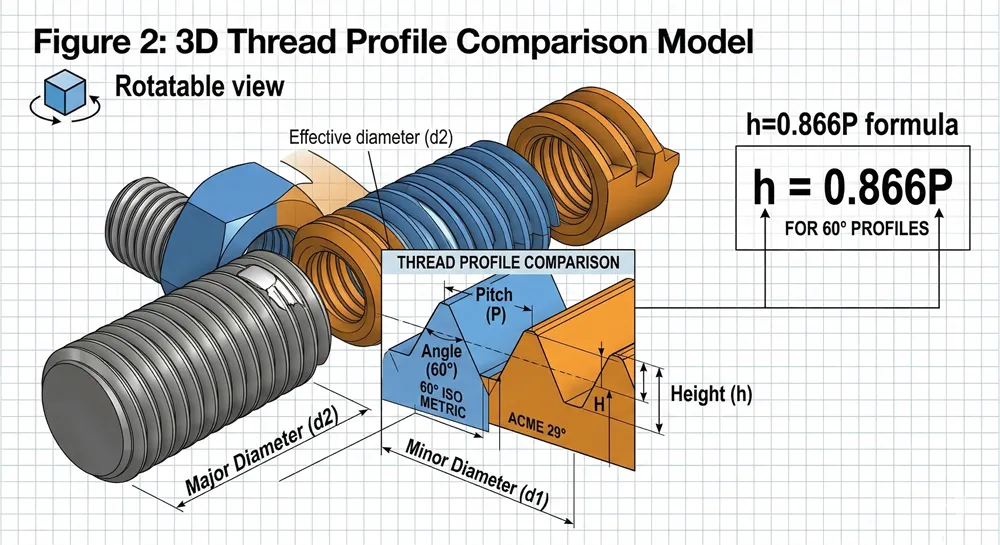
[Abbildung 2: 3D-Gewindeprofil-Vergleichsmodell (drehbare Ansicht mit Winkeln, Steigung P, Wirkdurchmesser d2, Höhe h; Formel h=0,866P für 60°-Profile)]
Wichtigste Erkenntnisse: Setzen Sie Prioritäten bei der Belastung und der Umgebung und passen Sie sie dann über eine Tabelle an, um eine Überplanung zu vermeiden und Kosten zu sparen. Leser-Fragen und Antworten: F: Wie berechnet man die Gewindefestigkeit? A: Verwenden Sie eine Finite-Elemente-Software oder σ = 4F/(πd2²), d2=wirksamer Durchmesser.
Internationale Normen und Toleranzsysteme erklärt
Normen sorgen für weltweite Interoperabilität. Hier ist eine klare Aufschlüsselung:
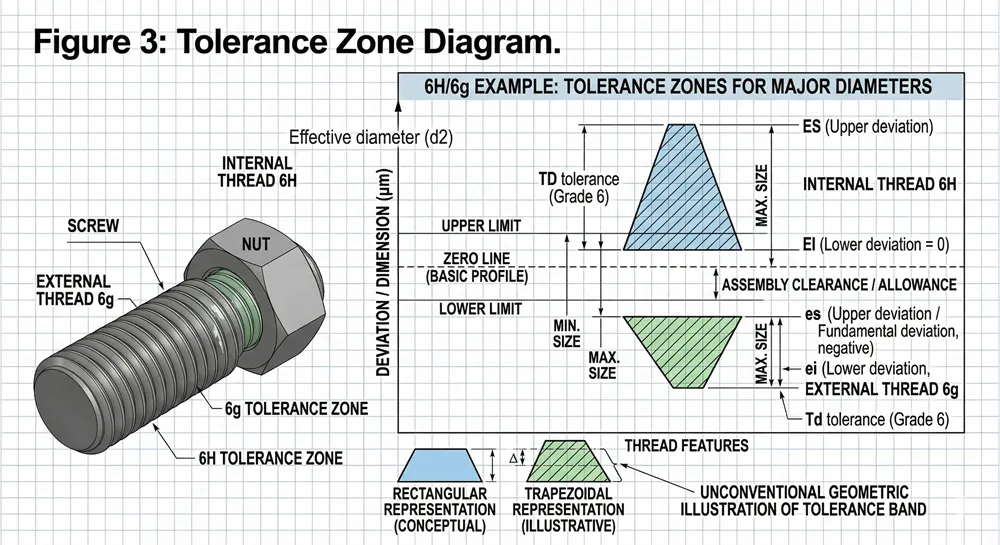
Allzweckgewinde: ISO 965 (metrische Profile, Toleranzen wie 6g Außendurchmesser untere Abweichung -0,02mm, 6H Innendurchmesser); ASME B1.1 (Unified UN, zollbasiert).
Getriebegewinde: ASME B1.5 (ACME); ISO 2901 (metrisch trapezförmig); DIN 103 (Stützenäquivalente).
Öl- und Gasgewinde: API Spec 5B (16. Aufl., 2017) für Abmessungen, Lehren; API 5CT für Rohrspezifikationen; ISO 13679 für CAL I-IV Dichtungsstufen (CAL I: einfaches Wasser; CAL IV: extremes Gas + Biegung).
Grundlagen der Toleranz: Steigungsfehler ΔP = ±0,015√L (L=Eingriffslänge mm); Toleranz des effektiven Durchmessers wirkt sich auf die Passung aus, Ovalität <0,01mm; Rohrgewinde konisch 1:16, Dichtfläche Ra≤3,2μm. Auswirkungen: Enge Toleranzen erhöhen die Kosten 20%, lose Toleranzen riskieren Leckagen.
Beispiel: 3/4-10UNC, 2A Toleranz, effektiver Durchmesser d2=0,6850 -0,0015/0 Zoll.
Wichtigste Erkenntnisse: Bevorzugen Sie ISO/ASME für weltweite Kompatibilität; prüfen Sie API für Öl und Gas, um die Austauschbarkeit zu gewährleisten.
Bearbeitungsmethoden für Gewinde: Vergleich und Auswahl
Technischer Hauptteil - Methodenvergleich mit Schritt-für-Schritt-Anleitungen für Benutzer von Werkzeugen aus Übersee.
Chip-Forming-Methoden (hohe Präzision):
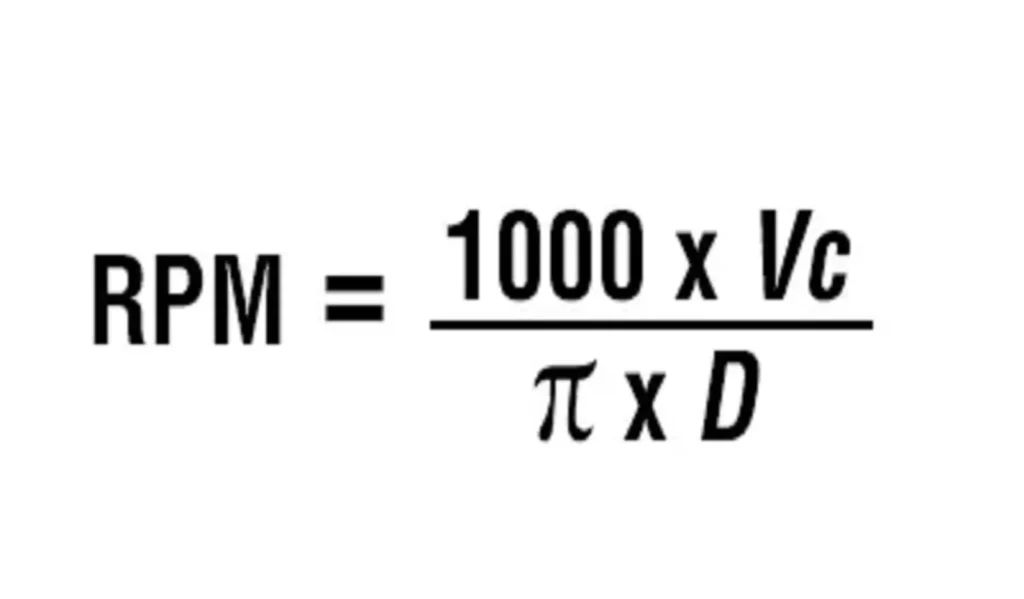
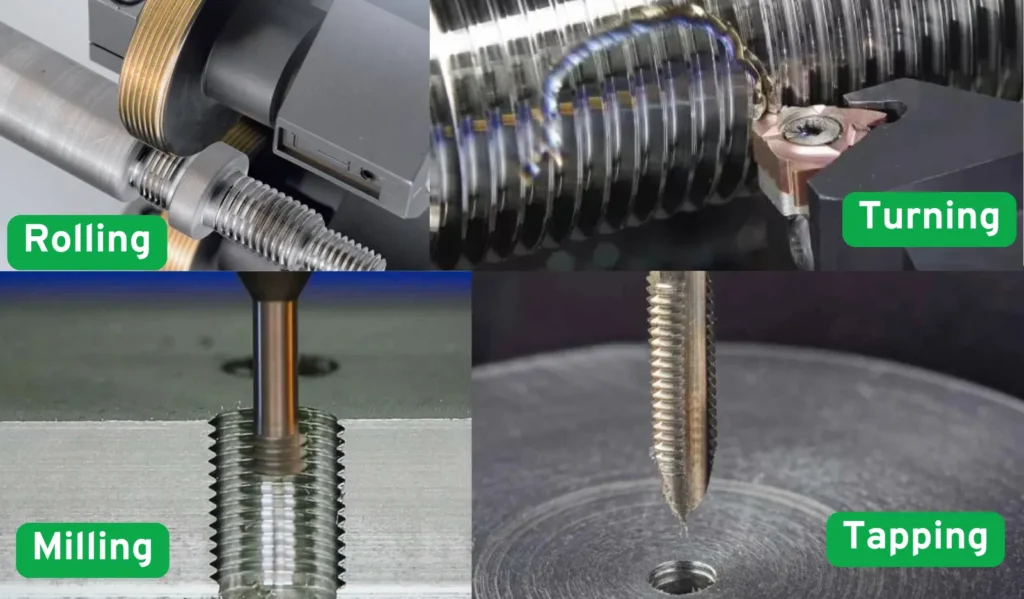
- Drehen: Manuelle Drehmaschinen oder CNC mit G76-Zyklen (Parameter: X-Ende, Z-Anfang, P-Teilung, Q-Min-Vorschub, R-Rückzug). Schritte: 1. Werkzeugausrichtung (Laser für effektiven Durchmesser); 2. mehrere Durchgänge mit abnehmender Tiefe (erster ap=0,3P, letzter 0,05P); 3. Hochdruckkühlmittel. Geeignet für Prototypen; Beispiel: AISI 1045 Stahl 3/4-16UN, Vc=500-700 ft/min, f=P=0,0625 in/rev.
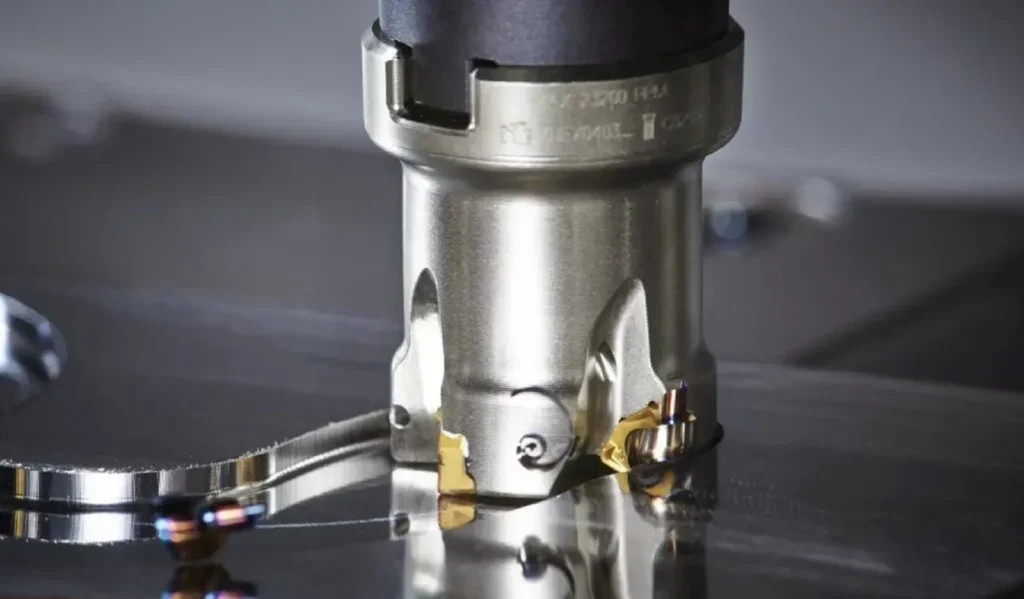
- Fräsen: CNC-Gewindefräsen (Mehrzahn- oder Einzelzahnfräsen), besonders geeignet für große Durchmesser (>2″) oder mehrgängige Gewinde. Makro: G02/G03 schraubenförmige Interpolation.
- Gewindeschneiden: Starre (synchronisierte Spindel) oder spiralförmige Fräsgewindebohrer. Vermeiden Sie Brüche bei Knackzyklen.
Spanlose Umformung (effizient, oberflächenhärtend):
- Walzen: Flachmatrizen (Großserien) oder zylindrische Räder (Präzision). Das Prinzip: Die plastische Verformung erzeugt Druckspannungen, die die Ermüdungslebensdauer um das 3-10fache erhöhen. Daten: AISI 1045 gewalzt Ra=8μin, Härte +20%.Schritte: 1. Effektiver Durchmesser vor dem Drehen d2= größer - 0,5P; 2. 10-20 Tonnen Kraft aufbringen; 3. 150-250 ft/min.
- Strangpressen: Kalt für Aluminium, heiß (1100°F) für Titan.
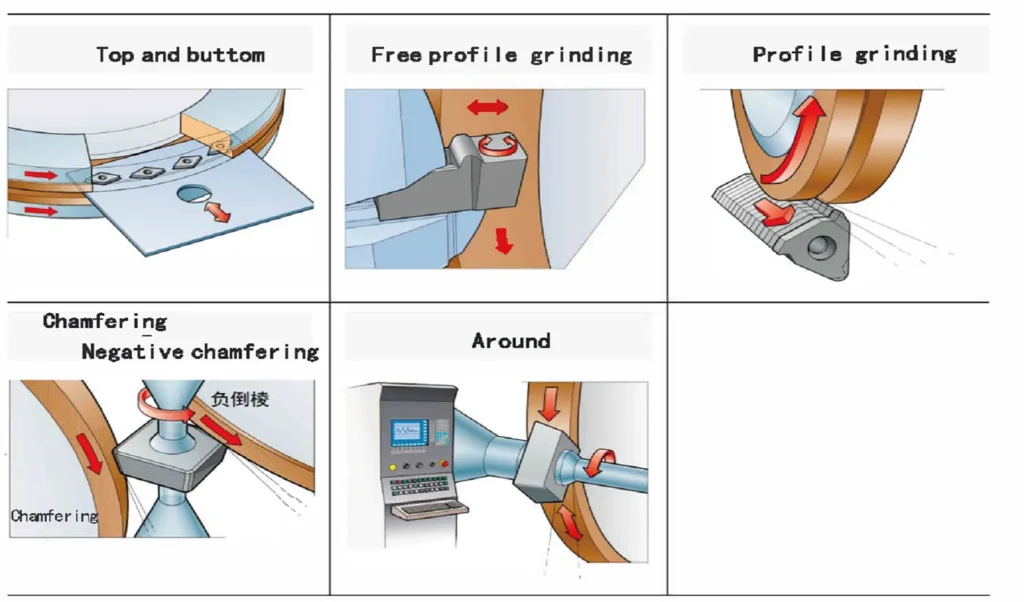
Schleifen und Präzision: Gewindeschleifmaschinen (abgerichtete Scheiben), für die Genauigkeit der Nachwärmebehandlung IT5.
Materialspezifische Strategien:
- Rostfrei: Niedrige Vc=300 ft/min, TiCN-beschichtete Werkzeuge zur Vermeidung von Abrieb.
- Titan: Hochdruck-Kühlmittel >700 psi, langsames f=0,004 in/rev, um Hitzerisse zu vermeiden.
- Superlegierungen: CBN-Einsätze, Trocken- oder MMS-Schneiden.
Methodenauswahl Entscheidungsbaum (Flowchart Style):
- Volumen >10.000 & gute Duktilität → Walzen (50% Kosteneinsparung).
- Toleranz IT4 & Härte >45HRC → Schleifen.
- Ölfeld Große Durchmesser: CNC-Drehen + Walzschultern + Phosphatbeschichtung.
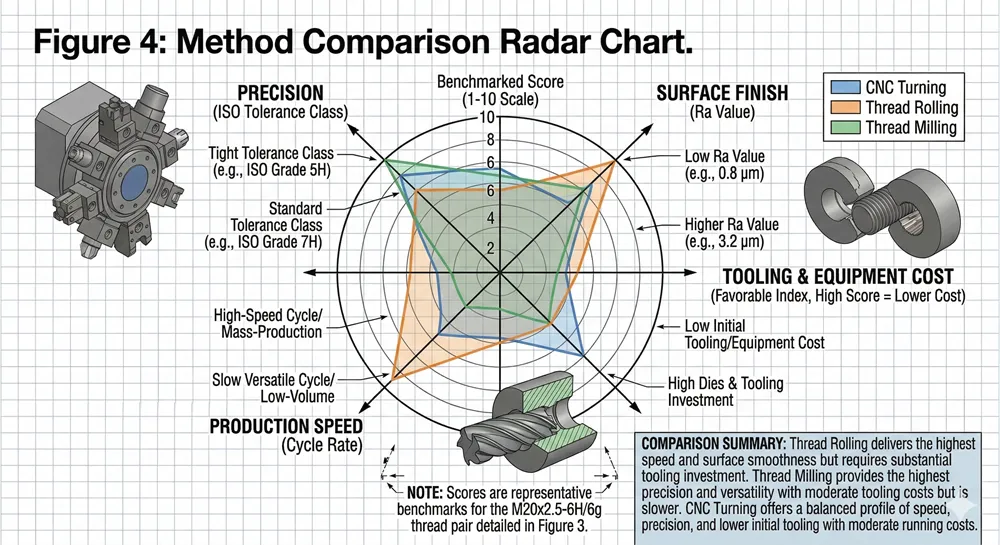
Vergleich: Drehen bietet Vielseitigkeit, aber geringere Geschwindigkeit; Walzen steigert die Effizienz in der Massenproduktion.
Wichtigste Erkenntnisse: Bevorzugen Sie chipless für Volumen; verwenden Sie Baum für Auswahl.
Ausrüstung, Werkzeuge und Einrichtungsgegenstände: Vollständige Aufschlüsselung
Die richtige Einstellung steigert die Effizienz 30% für globale Lieferanten.
- Schlüsselausrüstung: DMG Mori CTX Dreh-Fräs-Hybride (Mehrachsen); Mazak Integrex (Spezialist für Gewindefräsen); Haas VF CNCs; Gleason P90 Walzen (Ölfeld); Reishauer RZ Schleifmaschinen (Präzisionsgetriebe).
- Werkzeugbau-Systeme: Indexierbar Wendeschneidplatten (Sandvik CoroThread 266, Geometrie: 5° Spanwinkel, 7° Freiwinkel); Vollhartmetallgewindebohrer (Kennametal); Wälzräder (Cole Carbide, SKD11-Material, 100k Standzeit).
- Einrichtungsgegenstände: Spannzangenfutter (Verformungsschutz); schwingungsdämpfende Werkzeughalter (90%-Reduzierung); schwimmend gelagerte Gewindebohrerhalter (axialer Fehlerausgleich).
- Tipps zur Programmierung: Fanuc G76 (Code: G76 P021060 Q0.002 R0.001; G76 X0.709 Z-2. P0625 Q012 F0.0625); Makros für Gewindefräser mit Variablen #100=Steigung.
Tipp: Werkzeugstandzeit L = (C/Vc)^n * 60/T, C=konstant, n=Exponent.
Wichtigste Erkenntnisse: Passende Ausrüstungstools; Makros vereinfachen die Programmierung.
Prozessparameter-Optimierung und intelligente Steuerungen
Parameter definieren erfolgsoptimiert, um Schrott 20% zu schneiden.
Erweitertes Parameterverzeichnis (Nach Material):
| Material | Verfahren | Vc (ft/min) | f (Ein/Umdrehung) | ap (in) | Strategie zur Kühlung |
|---|---|---|---|---|---|
| Kohlenstoffstahl 1045 | Wenden | 500-720 | P | Abnehmend 0,012-0,002 | Interner Hochdruck >400 psi |
| Edelstahl 304 | Rollender | – | – | Kraft 10 Tonnen | MQL Minimalschmierung |
| Titan Ti-6Al-4V | Fräsen | 130-200 | 0.004 | 0.2P | Hochdruck + Schwingungsdämpfung |
Optimierungsschritte: 1. Baseline-Versuche; 2. orthogonale Taguchi-Anordnungen; 3. Simulation (z. B. Deform für die Verformungsvorhersage).
Intelligente Steuerungen: Vibrationssensoren (Schwellenwert <200 μin/s, automatische Reduzierung von f); thermische Kompensation (Lasertemperatur, Anpassung der Z-Achse); adaptive AI (Vc auto +10% aus Daten).
Beispiel: 1045 Drehungen, Grundlinie Vc=590, optimiert 720, +22% Durchsatz.
Wichtigste Erkenntnisse: Beginnen Sie mit einer Tabelle, verfeinern Sie sie durch Experimente.
Häufige Defekte: Analyse, Ursachen und Behebung
Fehlerbehebung wie bei der Diagnose - verwenden Sie Bäume für eine schnelle Lösung.
Erweitertes Fehlerdiagramm + Korrekturen:
| Defekt | Ursachenanalyse | Prävention | Abhilfe |
|---|---|---|---|
| Unvollständiges Profil/Gräben | Überdimensionierte Werkzeugnase oder keine Anfasung | Vorwendefase C=0,5P | Manuelles Entgraten + Fertigdrehen |
| Pitch Akkumulationsfehler | Spindelgeberfehler oder Q-Parameter-Fehlanpassung | Gittermaßstab kalibrieren, G76 erster Durchgang ausrichten | Neu programmieren + Offset messen |
| Effektiver Durchmesser Übermaß/Ovalität | Werkzeughöhe aus oder Vibration | Laser ausrichten + Feuchthalter | Korrektur schleifen |
| Ölfeld Galling/Kratzer | Schlechte Schmierung, zu hohes Drehmoment | Gewindemischung, Schulter Ra<63 μin | Phosphat + Reinigen |
| Getriebe Übermäßiges Spiel | Unzureichender Rollendruck | Kalibrieren auf 15 Tonnen | Paar einstellen oder austauschen |
Öl-spezifisch: Drehmomentschulter ungleichmäßig (Ursache: Rattern; Behebung: langsames Fertigdrehen).
Diagnosestruktur: Symptom → Ursache → Test (Überprüfung der Messgeräte) → Lösung.
Wichtigste Erkenntnisse80% von parameters-monitor early.
Qualitätsprüfung, Akzeptanzkriterien und Messwerkzeuge
Die Inspektion gewährleistet die Einhaltung der Vorschriften für weltweite Exporte.
Allgemeine Werkzeuge: Messdorne/Ringlehren (Gut/Schlecht); Profilprojektoren (50-fache Winkelvergrößerung); CMMs (Full Param Scan, 0,00004″ Genauigkeit).
Öl und Gas Spezifisch: API 5B-Messgeräte (Haupt-/Arbeitsmessgerät, Kegel/Höhe); Drehmoment-Drehprüfstände (Feldsimulation, 6000-9000 ft-lb); ISO 13679 Gasdichtungstests (Druckzyklen).
Zerstörungsfrei: Magnetpulver (Oberflächenrisse); Ultraschall (innen); Fluoreszierendes Eindringmittel (Dichtungen).
SPC-Integration: Statistische Prozesskontrolle, CpK>1,33 für Stabilität. Excel-track effektive Durchmesserverteilungen.
Schritte: 1. 10%-Probenahme; 2. Datenprotokoll; 3. Varianzanalyse.
Wichtigste Erkenntnisse: Werkzeuge + SPC = >99% Ertrag.
Anwendungen in der Industrie: Fallstudien und Kosten-Nutzen-Analyse
Beispiele aus der Praxis für Märkte in Übersee.
Öl & Gas Fall: K&B Industries (U.S.) fertigt Premium-Gewindeanschlüsse für Halliburton/BP. Verfahren: CNC-Drehen + Walzschultern + Fertigung. Ergebnis: 100+ lizenzierte Gewinde, erhöhte Drehmoment-/Druckbeständigkeit; Zykluszeit um 30% verkürzt, Kosten um 18% gesenkt (Werkzeugeinsparung 10%).Kostenaufschlüsselung: Werkstoffe 40%, Bearbeitung 30%, Inspektion 10%, Ausschuss 20%.
Bearbeitende Industrie: ACME-Gewindespindel für CNCs. Walzen + Schleifen nach IT5. Lebensdauer von 80k bis 250k Zyklen, Volumenkosten -45% (Walzen vs. Drehen).
Kfz-Befestigungselemente: Gewalzte 3/8-16UN Bolzen Linie. 5M/Jahr, Ermüdung +60%, Ausschuss <0,3%. ROI: 1,5 Jahre.
Globale Analyse: Schrott <2% spart 15%; Automatisierung spart Arbeit 20%.
Wichtigste Erkenntnisse: Fälle zeigen ROI <2 Jahre mit Optimierung.
Trends und Zukunftsaussichten
Das Einfädeln entwickelt sich zu intelligenten, nachhaltigen globalen Praktiken.
Intelligente Fertigung: Adaptive KI-Parameter (vibrationsbasierte Vc-Abstimmung); Digitale Zwillinge (50%-Defektvorhersage); 5G-Echtzeitprüfung.
Grüne Prozesse: MMS/Trockenwalzen (80% weniger Flüssigkeit); Laserunterstütztes Drehen (Titan Vc +50%); Additiv + Nachwalzen (kundenspezifische Mikros, -40% Kosten).
Globale Versorgungstrends: Überseemärkte bevorzugen Hartmetallwerkzeuge (CAGR 7,2%); Anbieter wie Sandvik führen bei Premium-Verbindungen.
Schlussfolgerung: Gewindeschneiden ist die Grundlage der Präzisionsfertigung - nutzen Sie diesen Leitfaden, um Ihre globalen Abläufe zu verbessern! Teilen Sie uns Ihre Herausforderungen in den Kommentaren mit, damit wir Ihnen Fragen beantworten oder eine kostenlose Excel-Vorlage für Prozesskarten zur Verfügung stellen können (Download am Ende).
Einfädeln prozesskarte Excel Vorlage: Eingaben für Materialien, Parameter, Fehler; automatische Berichte.
FAQs
Referenzen (Erweitert)
[1] ISO 965-1:2013 Metrische Schraubengewinde-Toleranzen. Internationale Organisation für Normung.
[2] API-Spezifikation 5B, 16. Auflage, 2017. American Petroleum Institute.
[3] ISO 13679:2019 Erdöl- und Erdgasanschlussprüfung. ISO.
[4] ASME B1.1-2019 Unified Inch Screw Threads. Amerikanische Gesellschaft der Maschinenbauingenieure.
[5] Taguchi G. Einführung in die Qualitätstechnik. Asiatische Produktivitätsorganisation, 1986.