The Superiority of Thread Whirling over Single-Point Turning for Titanium Bone Screws (ISO 5835)
I. Introduction: The Demands of Medical Machining
A. The Rise of Titanium Implants: A Material Mandate Modern orthopedic surgery relies heavily on advanced materials, with Titanium alloys—specifically Ti-6Al-4V ELI (Extra Low Interstitial)—dominating the landscape. Its exceptional strength-to-weight ratio, superior fatigue resistance, and absolute biocompatibility make it the gold standard for skeletal fixation. However, the very metallurgical properties that make titanium ideal for the human body—its extreme toughness and low thermal conductivity—also make it notoriously difficult to machine. This creates a high-stakes environment where standard tooling solutions frequently fail, driving the need for highly specialized machining strategies.
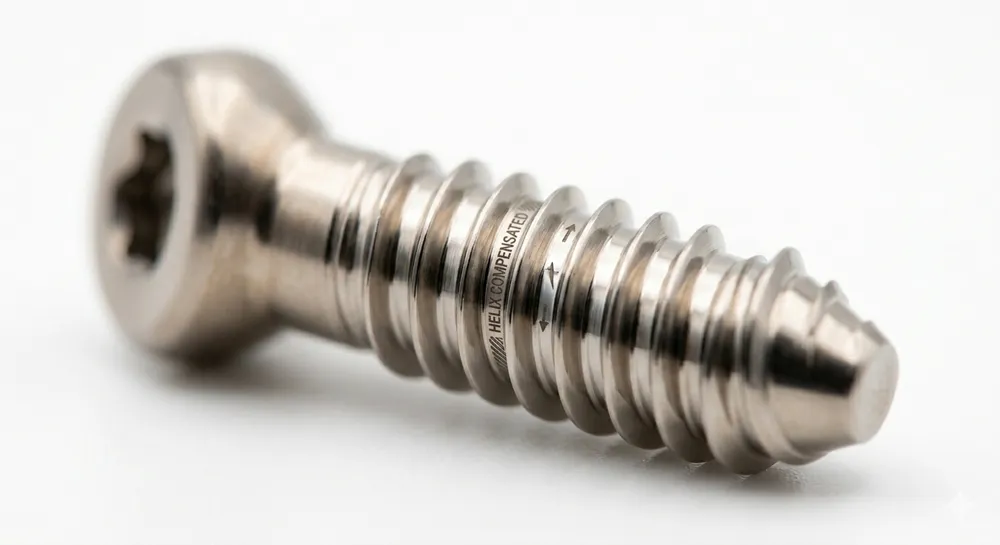
B. The ISO 5835 Standard: Engineered for Anchorage At the core of effective orthopedic fixation is the ISO 5835 standard, which dictates the precise geometry of metal bone screws. Unlike standard symmetrical threads used in general industrial applications, ISO 5835 requires a highly specialized asymmetrical thread profile.
- Purpose-Driven Geometry: Whether it is the shallower HA (Cortical) thread for hard outer bone or the deeper HB (Cancellous) thread for spongy inner bone, these profiles feature a distinct, near-vertical load-bearing flank (typically 3°) to maximize pull-out resistance, and a wider leading flank (typically 35°) to facilitate smooth insertion.
- Zero Margin for Error: Reproducing this exact asymmetry, along with perfectly blended root radii, is non-negotiable. Any deviation compromises the implant’s holding power and violates strict medical compliance standards.
C. The Manufacturing Bottleneck: Precision at the Micro-Scale Manufacturing these critical implants presents a perfect storm of engineering challenges. Bone screws inherently possess an extreme length-to-diameter (L/D) ratio, making them highly susceptible to bending and vibration during machining. When this micro-scale fragility is combined with the deep, aggressive thread profiles required by ISO 5835 and the rapid work-hardening characteristics of titanium, traditional machining methods hit a hard performance ceiling. This bottleneck drives up cycle times, accelerates tool wear to unsustainable levels, and introduces unacceptable risks of surface defects (such as micro-burrs)—necessitating a fundamental kinematic shift in how these threads are generated.
II. The Mechanical Pitfalls of Single-Point Turning (Why it Fails)
While single-point threading remains a staple in general manufacturing, applying it to the production of titanium bone screws exposes fundamental mechanical limitations. Attempting to machine deep, asymmetrical ISO 5835 profiles using traditional turning methods consistently leads to a triad of manufacturing failures.
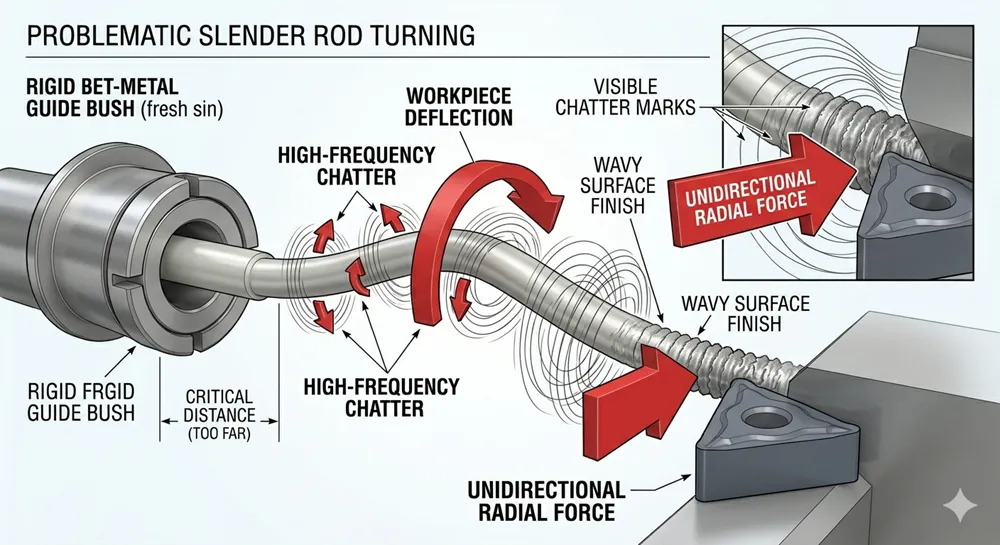
A. The Deflection Dilemma (Radial Forces and Rigidity) By design, bone screws are incredibly slender, frequently exhibiting an extreme length-to-diameter (L/D) ratio. In standard single-point turning, the cutting insert engages the workpiece from a single direction. This action generates tremendous unidirectional radial cutting forces that push directly against the side of the titanium rod. Due to its slender profile, the workpiece lacks the structural rigidity to withstand this pressure and naturally deflects (pushes away) from the tool. This deflection inevitably results in dimensional taper (where the thread depth varies along the length of the screw), severe chatter marks (vibration), and, in worst-case scenarios, permanent bending of the implant.
B. The Titanium Work-Hardening Trap The metallurgical properties of Ti-6Al-4V ELI further compound the problem. Titanium has notoriously poor thermal conductivity, meaning the intense heat generated during machining concentrates directly at the cutting zone rather than dissipating into the chips. Because a deep HA or HB thread profile cannot be formed in a single turning pass, single-point threading requires multiple repetitive passes—often 10 to 20 cycles—to reach the final root depth. Here lies the trap: Titanium rapidly work-hardens when deformed. With every successive pass, the cutting insert is forced to plunge into a newly hardened, highly abrasive surface layer created by the previous cut. This relentless cycle drastically accelerates tool wear, induces microscopic edge chipping, and leads to unpredictable, economically unviable tool life.
C. Compromised Surface Integrity and Burr Formation In the medical device industry, surface finish is not a cosmetic preference; it is a strict biological necessity. Any microscopic burrs, material smearing, or tearing on the thread flanks can cause tissue irritation or harbor bacteria post-implantation. The repeated dragging and shearing action inherent in multi-pass single-point turning makes it almost impossible to avoid material folding and burr formation, particularly on the delicate thread crests. Eradicating these microscopic defects requires costly, inconsistent, and time-consuming secondary deburring operations, which still cannot guarantee the pristine, “as-machined” surface integrity demanded by regulatory bodies.
III. The Thread Whirling Solution: A Kinematic Paradigm Shift
To overcome the inherent limitations of conventional turning, the medical manufacturing sector relies on thread whirling—a process that represents a fundamental kinematic paradigm shift. When integrated into Swiss-type CNC lathes, thread whirling transforms the chaotic and destructive forces of titanium machining into a highly controlled, balanced, and efficient operation.
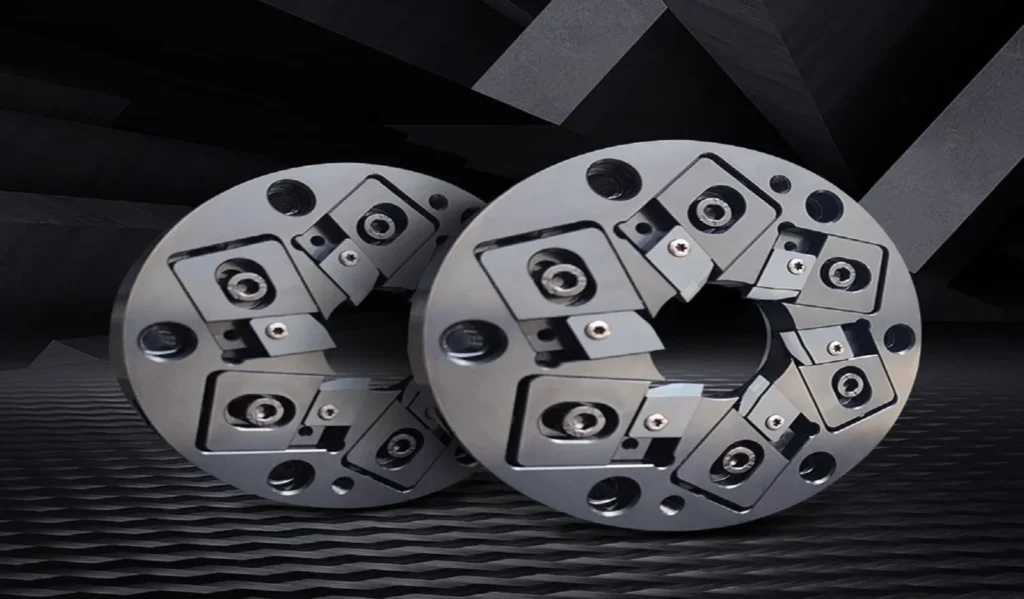
A. The Mechanics of Whirling: Eccentric Precision Unlike single-point turning, where the workpiece rotates rapidly against a stationary tool, thread whirling utilizes a high-speed cutter ring (the whirling head) equipped with multiple custom-profiled inserts (typically 3 to 6). This ring rotates eccentrically around the slowly rotating and axially feeding workpiece. The cutting edges intersect the titanium rod at a precise angle corresponding to the thread’s helix, carving out the exact ISO 5835 profile with absolute fidelity.
B. Balanced Cutting Forces: Eliminating Deflection The most critical advantage of thread whirling lies in its force distribution. Because the whirling ring surrounds the slender workpiece, the cutting forces generated by the multiple inserts are directed centripetally (inward toward the center axis). These forces effectively cancel each other out. Furthermore, this cutting action occurs mere millimeters away from the machine’s guide bush. This synchronized, balanced inward pressure acts as a dynamic support system, completely eliminating radial deflection and allowing for the precise machining of extremely long bone screws without any bending or chatter marks.
C. The “One-Pass” Advantage: Conquering Titanium Thread whirling completely bypasses the catastrophic work-hardening trap associated with titanium alloys. The whirling process is mathematically engineered to achieve the full thread depth (APMX) in a single, uninterrupted pass directly from the raw bar stock. By taking the thread to full depth immediately, the cutting edges consistently engage virgin, unhardened material. This true “one-pass” shearing action not only preserves the ultra-sharp edge of the inserts—exponentially increasing tool life—but also slashes cycle times from several minutes down to mere seconds.
IV. Key Advantages of Whirling for ISO 5835 Profiles
The transition from single-point turning to thread whirling is not merely an incremental improvement; it is a transformative upgrade. For manufacturers producing ISO 5835 bone screws, this specialized process delivers three distinct, non-negotiable advantages that directly impact both implant quality and bottom-line profitability.
A. Absolute Dimensional Accuracy (Profile Fidelity) The asymmetrical nature of the ISO 5835 standard leaves zero room for dimensional deviation. Thread whirling guarantees absolute profile fidelity because the cutting inserts act as a perfect “negative” of the desired thread form. When the whirling ring’s inclination is precisely matched to the screw’s helix angle, the cutters replicate the complex geometry—including the critical 35° leading flank, the 3° trailing flank, and the exacting root radii (e.g., R0.8 and R0.2)—directly onto the titanium rod. Because deflection is eliminated, this accuracy remains perfectly consistent from the first thread pitch to the last, ensuring 100% adherence to rigorous medical tolerances.
B. Superior Surface Finish (Burr-Free Execution) In orthopedic applications, the surface integrity of an implant directly dictates its clinical success. Thread whirling operates on an “interrupted shearing” principle. Rather than continuously dragging through the metal, the whirling inserts rapidly slice into and exit the titanium, generating tiny, comma-shaped chips that efficiently carry heat away from the cutting zone. This clean, high-speed shearing action completely prevents the material tearing, smearing, and plastic deformation commonly seen in turning. The result is a pristine, burr-free, and mirror-like surface finish right off the machine, effectively eliminating the need for hazardous and expensive secondary deburring operations.
C. Exponential Productivity Gains (The Commercial Edge) Beyond engineering perfection, thread whirling fundamentally rewrites the economics of medical machining. By completing the full depth of the HA or HB thread profile in a single pass, cycle times are exponentially compressed. A titanium bone screw that might take several minutes to thread via traditional multi-pass turning can be fully whirled in a matter of seconds. When combined with the dramatically extended tool life—achieved by avoiding work-hardened material and utilizing optimized micro-grain carbide inserts—manufacturers experience a massive reduction in machine downtime and a significantly lower cost-per-part (CPP).
V. Critical Considerations for Custom Insert Design (R&D Focus)
Transitioning from standard catalog tooling to custom-engineered thread whirling inserts requires a profound understanding of both the ISO 5835 thread profile and the metallurgy of titanium. To achieve optimal performance, tool life, and thread quality, our R&D approach focuses on four critical design pillars.
A. Substrate Selection: The Foundation of Edge Strength
Titanium machining generates intense, localized heat and significant mechanical stress at the cutting edge. Standard carbide grades are insufficient. Our custom inserts are engineered using ultra-fine micro-grain carbide (typically in the 0.5 µm to 0.8 µm grain size range). We strictly utilize unalloyed WC-Co (Tungsten Carbide-Cobalt) substrates, explicitly avoiding Titanium Carbide (TiC) or Tantalum Carbide (TaC) additives that increase chemical affinity and cause built-up edge (BUE) when cutting titanium.
B. Macro and Micro Geometry: The “Shear” Strategy
To combat titanium’s elasticity and low thermal conductivity, the cutting geometry must prioritize a clean shearing action over plastic deformation.
- Macro-Geometry: We incorporate extreme high positive rake angles (15° to 25°) to reduce cutting forces and direct heat into the chip rather than the workpiece. Simultaneously, generous clearance angles (8° to 15°) are calculated to prevent the severe abrasive friction caused by titanium’s natural spring-back effect.
- Micro-Geometry (Edge Preparation): Unlike inserts for machining steel, which often feature heavily honed edges, our titanium inserts maintain an “up-sharp” edge preparation. A strictly controlled, microscopic edge treatment is applied only to prevent premature micro-chipping, striking the perfect balance between absolute sharpness and edge integrity.
C. The Mathematical Core: Helix Angle Compensation
This is the most critical step where standard engineering fails. The 2D dimensions provided in standard ISO 5835 blueprints (e.g., TP=1.5mm, $\alpha$=35°, $\beta$=3° for an HA4.0 profile) represent the perfect axial cross-section of the screw. However, during whirling, the cutting head is tilted to match the thread’s helix angle.
If a 2D profile is ground directly onto an insert without compensation, the resulting thread will suffer from severe profile distortion and flank interference. Our engineering team utilizes advanced CAD/CAM modeling to calculate the exact 3D projection deformation based on the screw’s outer diameter and pitch. The cutting edge is geometrically compensated before grinding, ensuring the final whirled thread perfectly matches the ISO standard.
D. Surface Treatment Strategy: Polished vs. Coated
Friction is the enemy of titanium machining. Our primary strategy for initial development and high-precision applications is the use of highly polished, uncoated inserts. Achieving a mirror-like finish on the rake face (Ra < 0.1µm) drastically reduces friction and material adhesion. For ultra-high-volume production environments where extended tool life is paramount, we utilize extremely thin, ultra-smooth PVD coatings (such as AlTiN) applied with advanced droplet-removal post-polishing, specifically optimized for titanium alloys.
VI. Conclusion: Engineering the Future of Medical Machining
The production of ISO 5835 titanium bone screws is a high-stakes manufacturing challenge that demands uncompromising precision and efficiency. Single-point turning, hindered by deflection, work-hardening, and poor tool life, is structurally inadequate for this task.
Thread whirling represents the definitive kinematic solution. By neutralizing radial forces and enabling one-pass, burr-free machining, it ensures perfect dimensional fidelity and surface integrity while exponentially increasing productivity. However, the true potential of thread whirling is only unlocked through the deployment of highly specialized, custom-engineered cutting inserts. Through rigorous control of carbide substrates, perfectly compensated geometries, and optimized edge preparations, we are committed to delivering tooling solutions that empower medical manufacturers to achieve world-class quality at a significantly lower cost per part.
FAQ
References & Further Reading
- International Organization for Standardization (ISO) For the official technical specifications, dimensional requirements, and geometric tolerances of asymmetrical cortical and cancellous bone screw threads, refer to the published standard: ISO 5835:1991 – Implants for surgery — Metal bone screws — Asymmetrical thread
- WTO Precision Toolholders To understand the mechanical kinematics, RPM capabilities, and stability requirements of the driven toolholder units that power the thread whirling process: WTO Thread Whirling Technology
- Tornos: Swiss-Type Machining Explore the advanced Swiss-type CNC lathes and guide-bush technology specifically engineered to handle the micro-precision demands of the medical device industry: Tornos Medical Micro-Machining Solutions