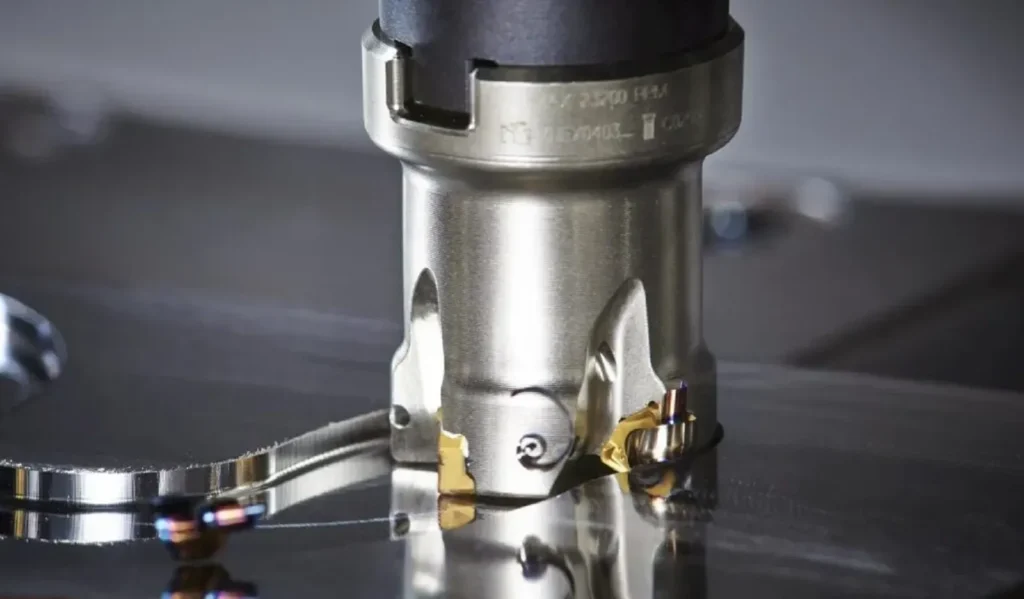
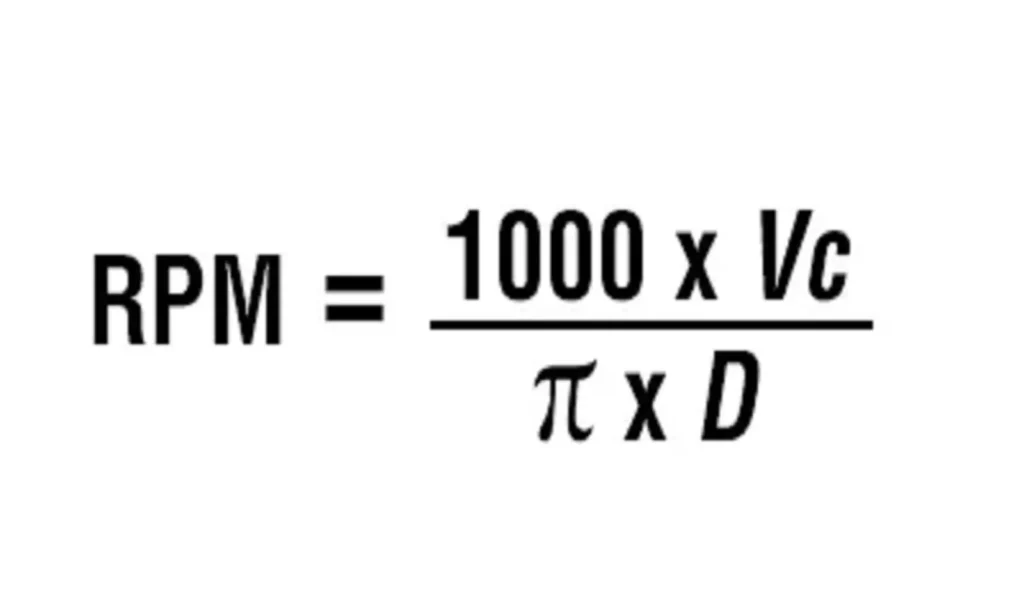
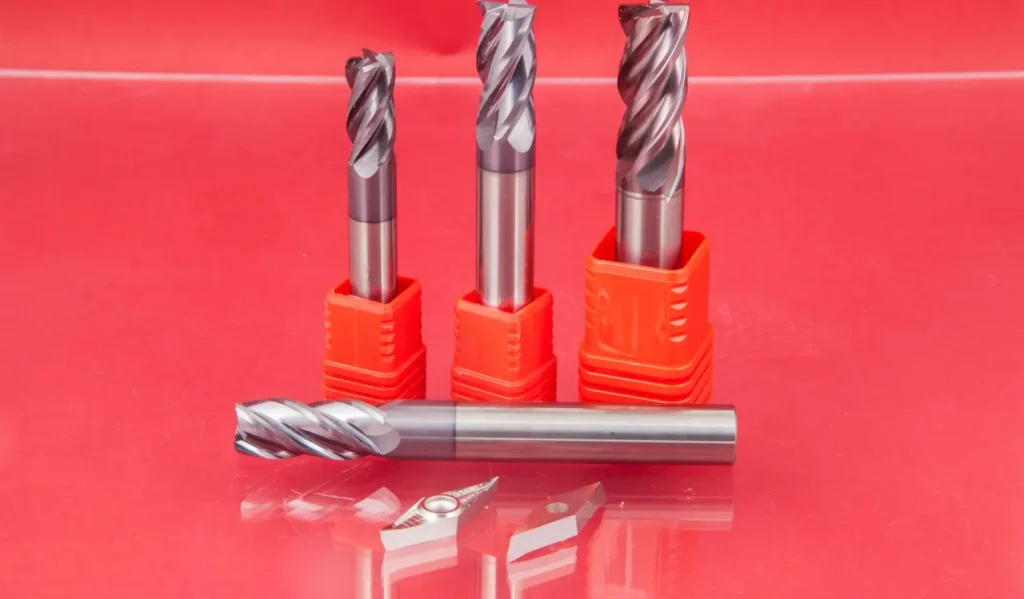
Bull nose and ball nose end mills are both widely used in CNC milling, but their cutting geometries make them suitable for different machining applications.
A bull nose end mill features a flat cutting end with rounded corners, making it suitable for machining flat surfaces, pockets, and features with radiused internal corners. A ball nose end mill has a fully rounded, hemispherical cutting tip, making it ideal for 3D contouring, curved surfaces, and mold and die machining.
The main difference between a boğa burunlu parmak freze and a ball nose end mill is the geometry of the cutting end. Choosing the right tool depends on workpiece geometry, surface finish requirements, material removal needs, and machining conditions.
In this guide, we compare bull nose vs ball nose end mills, explain their cutting characteristics, and show when to use each tool for better CNC machining results.
1. Quick Comparison: Bull Nose End Mill vs Ball Nose
Before looking at each tool in detail, here is a quick comparison of their main characteristics.
| Comparison Factor | Boğa Burunlu Freze | Bilyalı Uçlu Freze |
|---|---|---|
| Kesme geometrisi | Flat end with rounded corners | Fully hemispherical end |
| Köşe radyüsü | Smaller than half the tool diameter | Equal to half the tool diameter |
| Bottom cutting profile | Flat cutting face | Curved cutting face |
| En iyi uygulamalar | Flat-bottom pockets, side milling, and radiused corners | 3D contouring, curved surfaces, and mold machining |
| Yüzey işleme | Suitable for flat floors and radiused transitions | Suitable for complex curved surfaces |
| Material removal | Effective for flat-bottom and side-milling operations | Particularly useful for complex 3D profiles |
| Typical toolpath | Pocketing, profiling, and planar milling | 3D konturlama ve yüzey bitirme |
| En önemli avantajı | Combines a flat cutting end with corner protection | Produces continuous curved profiles |
Which one should you choose?
- Choose a boğa burunlu parmak freze when you need a flat bottom with rounded internal corners.
- Choose a ball nose end mill when machining complex 3D contours and curved surfaces.
- Choose a square end mill when the workpiece requires flat bottoms with sharp internal corners.
The right choice should always match the actual workpiece geometry and machining requirements.
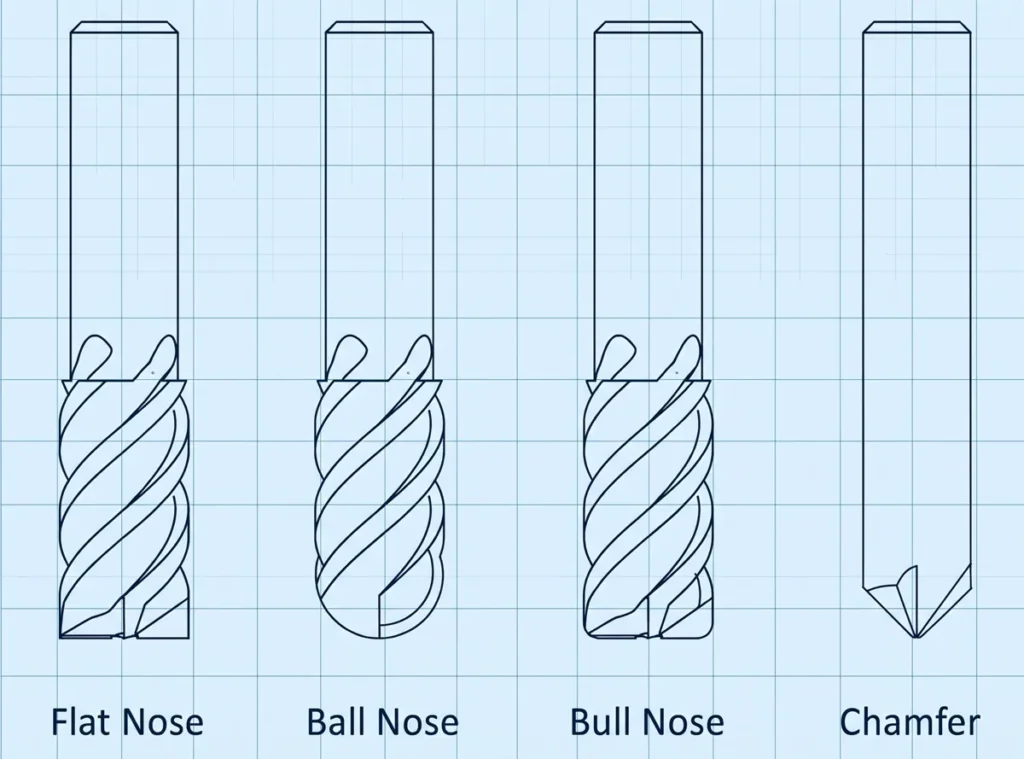
2. What Is a Bull Nose End Mill?
A bull nose end mill, also known as a corner radius end mill, is a milling cutter with a flat cutting end and rounded corners.
It combines the flat-bottom machining capability of a square end mill with a rounded cutting corner that helps reduce the sharp corner geometry found on conventional square end mills.
Bull Nose End Mill Geometry
The defining feature of a bull nose end mill is its corner radius.
Unlike a ball nose end mill, which has a complete hemispherical cutting tip, a bull nose end mill retains a flat cutting face.
For a standard bull nose profile:
- D represents the cutting diameter.
- R represents the corner radius.
- The corner radius is smaller than half the cutting diameter.
In other words:
R < D/2
The selected corner radius determines the radius left at the corresponding machined internal corner.
A larger corner radius produces a larger internal radius, while a smaller corner radius allows the tool to machine tighter transitions.
Common Applications of Bull Nose End Mills
Bull nose end mills are commonly used for:
Flat-Bottom Pocketing
The flat cutting end is suitable for machining pocket floors while the rounded corners create radiused transitions.
Yan Frezeleme ve Profilleme
They can be used for machining profiles where a rounded cutting corner is preferred over a sharp square edge.
Floor-to-Wall Transitions
A bull nose end mill can machine features with a specified radius where the pocket floor meets the sidewall.
Yarı Bitirme
The combination of a flat cutting face and rounded corners makes this tool useful for removing material while maintaining the required corner geometry.
Mold and Die Components
Bull nose end mills are useful for machining features that combine flat areas, shoulders, and rounded internal corners.
Advantages and Limitations of Bull Nose End Mills
Avantajlar:
- Suitable for flat-bottom machining.
- Produces controlled corner radii.
- Reduces the sharp cutting corner associated with square end mills.
- Useful for pocketing, profiling, and semi-finishing.
- Can machine both flat surfaces and radiused transitions.
Limitations:
- Cannot produce a fully hemispherical profile like a ball nose end mill.
- The corner radius must match the required workpiece geometry.
- Not the best choice for complex freeform 3D surface finishing.
Explore our solid carbide bull nose end mills to compare available tool families and corner radius specifications.
3. What Is a Ball Nose End Mill?
A ball nose end mill is a milling cutter with a fully rounded, hemispherical cutting tip.
Unlike a bull nose end mill, it does not have a flat bottom cutting face. Its cutting profile forms a continuous curved surface.
Ball nose end mills are widely used in CNC machining applications that require complex contours, curved profiles, and smooth transitions between different surface geometries.
Ball Nose End Mill Geometry
The defining characteristic of a ball nose end mill is its full-radius cutting tip.
For a standard ball nose profile:
- D represents the cutting diameter.
- R represents the ball radius.
- The ball radius equals half the cutting diameter.
Dolayısıyla:
R = D/2
For example, a ball nose end mill with a cutting diameter of 10 mm has a nominal ball radius of 5 mm.
This geometry allows the tool to follow complex 3D toolpaths and machine curved surfaces.
Common Applications of Ball Nose End Mills
3 Boyutlu Şekillendirme
Ball nose end mills are widely used for machining complex 3D surfaces in CNC machining centers.
Mold and Die Machining
They are suitable for machining mold cavities, curved walls, sculptured surfaces, and other complex profiles.
Yüzey İşleme
Ball nose tools are frequently used for finishing curved surfaces where the required surface quality depends on tool diameter, stepover, toolpath strategy, and machining conditions.
Turbine Blade and Aerospace Components
Their rounded geometry makes them useful for machining certain complex aerodynamic profiles and freeform surfaces.
Complex Curved Features
Ball nose end mills can follow curved toolpaths to machine geometries that are difficult to produce using flat-bottom cutters.
Advantages and Limitations of Ball Nose End Mills
Avantajlar:
- Suitable for complex 3D contouring.
- Produces continuous curved profiles.
- Useful for mold and die finishing.
- Supports machining of sculptured surfaces.
- Provides flexibility for complex CNC toolpaths.
Limitations:
- Not ideal when a completely flat-bottom surface is required.
- Surface quality depends heavily on stepover and toolpath strategy.
- Effective cutting diameter changes with axial depth of cut.
- The tool center has zero theoretical surface cutting speed when the tool axis is perpendicular to the workpiece.
Explore our solid carbide ball nose end mills for available tool families and dimensional specifications.
4. Bull Nose End Mill vs Ball Nose: Key Differences
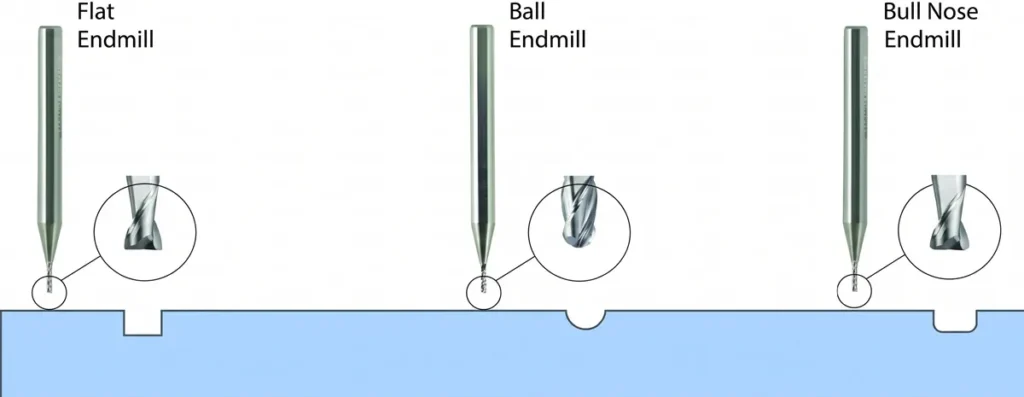
Although both tools have rounded cutting geometry, they are designed for different machining requirements.
4.1 Cutting Geometry
The most important difference is the shape of the cutting end.
A bull nose end mill has a flat bottom with a smaller corner radius. It combines flat-bottom cutting with rounded internal corners.
A ball nose end mill has a complete hemispherical cutting tip, with a radius equal to half its cutting diameter.
This difference determines the type of workpiece geometry each tool can machine efficiently.
4.2 Flat-Bottom Machining
Bull nose end mills are generally more suitable for machining flat-bottom pockets and floors because they have a flat cutting face.
Ball nose end mills can machine flat areas through overlapping toolpaths, but their rounded geometry creates a scalloped surface between adjacent passes.
If a flat surface with sharp internal corners is required, a square end mill may be a better option.
4.3 Corner Radius and Workpiece Geometry
Bull nose end mills are suitable when the workpiece requires a specific internal corner radius.
The corner radius can be selected according to the required part geometry.
Ball nose end mills produce a continuous curved profile based on their full ball radius.
For this reason, the two tools should not be considered interchangeable when the required workpiece geometry is different.
4.4 Surface Finish
Both tools can produce good surface finishes when used under appropriate cutting conditions, but their strengths differ.
Bull nose end mills are useful for machining flat floors and transitions with defined corner radii.
Ball nose end mills are particularly useful for finishing curved surfaces and complex 3D contours.
With ball nose milling, the stepover distance plays an important role in determining the remaining scallop height between adjacent passes.
A smaller stepover generally produces a finer theoretical surface finish but increases machining time.
4.5 Material Removal Rate
Neither tool has a universally higher material removal rate.
Bull nose end mills can be advantageous for machining flat floors and profiles because their flat cutting geometry engages the workpiece differently from a ball nose cutter.
Ball nose end mills are often preferred for complex 3D surfaces where their rounded geometry allows the tool to follow the required contour.
Actual material removal rates depend on:
- Kesme çapı
- Flüt sayısı
- Axial and radial depth of cut
- Feed rate and spindle speed
- İş parçası malzemesi
- Tool overhang and machine rigidity
- Toolpath strategy
The tool geometry should therefore be evaluated together with the machining parameters.
4.6 Cutting Edge Strength and Tool Rigidity
A bull nose end mill has a rounded cutting corner rather than the sharp 90-degree corner found on a square end mill.
This corner radius can help reduce stress concentration and the risk of corner chipping compared with a sharp square profile.
A ball nose end mill also has a rounded cutting profile without a sharp bottom corner.
However, it is not accurate to claim that one tool is always stronger than the other.
Actual tool strength and deflection depend on the tool diameter, core geometry, flute length, overhang, carbide grade, and cutting load.
4.7 Toolpath and CNC Programming
Bull nose end mills are commonly used for pocketing, side milling, profiling, and machining flat surfaces with radiused corners.
Ball nose end mills are frequently used with 3D contouring strategies and surface-finishing toolpaths.
For ball nose finishing, CAM programming must account for the stepover distance, tool radius, surface curvature, and required surface quality.
The appropriate toolpath depends on the geometry of the part rather than simply the type of end mill.
5. When Should You Use a Bull Nose or Ball Nose End Mill?
The following guide can help you select the right tool for different machining operations.
| İşleme Gereksinimi | Önerilen Araç | Sebep |
|---|---|---|
| Flat-bottom pocket with rounded internal corners | Bull Nose | Flat cutting face and controlled corner radius |
| Floor-to-wall fillet | Bull Nose | Suitable for machining a defined corner transition |
| Flat surface with sharp internal corners | Kare Freze | Produces sharp internal corners |
| Complex 3D contouring | Yuvarlak Uç | Fully rounded cutting tip follows curved profiles |
| Mold cavity finishing | Yuvarlak Uç | Suitable for sculptured surfaces and complex contours |
| Curved surface finishing | Yuvarlak Uç | Continuous rounded cutting profile |
| Flat-bottom semi-finishing | Bull Nose | Suitable for flat floors and radiused corners |
| Mixed flat and curved geometry | Depends on the part | Different tools may be needed for different features |
Choosing a Bull Nose End Mill for Flat-Bottom Pockets
If your workpiece contains flat-bottom pockets with rounded internal corners, a bull nose end mill is usually a suitable choice.
The flat cutting face machines the pocket floor, while the corner radius produces the required transition.
The corner radius should be selected according to the design drawing.
Choosing a Ball Nose End Mill for 3D Contouring
For complex 3D surfaces, a ball nose end mill is generally more suitable.
Its rounded cutting tip can follow curved profiles and sculptured geometries through appropriate CAM toolpaths.
This makes it a common choice for mold and die machining, turbine components, and other applications requiring complex surface profiles.
6. Ball Nose Milling: Effective Cutting Diameter and Surface Finish
One important factor when using a ball nose end mill is its effective cutting diameter.
The effective cutting diameter can be smaller than the nominal tool diameter when the axial depth of cut is less than the full ball radius.
What Is the Effective Cutting Diameter?
When a ball nose end mill is positioned perpendicular to a flat workpiece, the cutting speed at the exact center of the ball tip is theoretically zero.
As the axial depth of cut increases from the tip, a larger portion of the ball profile engages the workpiece.
The effective cutting diameter therefore changes with the axial depth of cut.
For a standard ball nose profile without tool tilt, a simplified geometric relationship is:
D_eff = 2 × √(2 × R × a_p − a_p²)
Nerede?
- D_eff = Effective cutting diameter
- R = Ball radius
- a_p = Axial depth of cut measured from the ball tip
When the axial depth of cut is smaller than the ball radius, the effective cutting diameter is smaller than the nominal tool diameter.
This is important when calculating spindle speed based on the actual cutting engagement.
Machinists should use the tool manufacturer’s cutting recommendations and appropriate CAM compensation rather than automatically applying the nominal diameter.
How Does Stepover Affect Surface Finish?
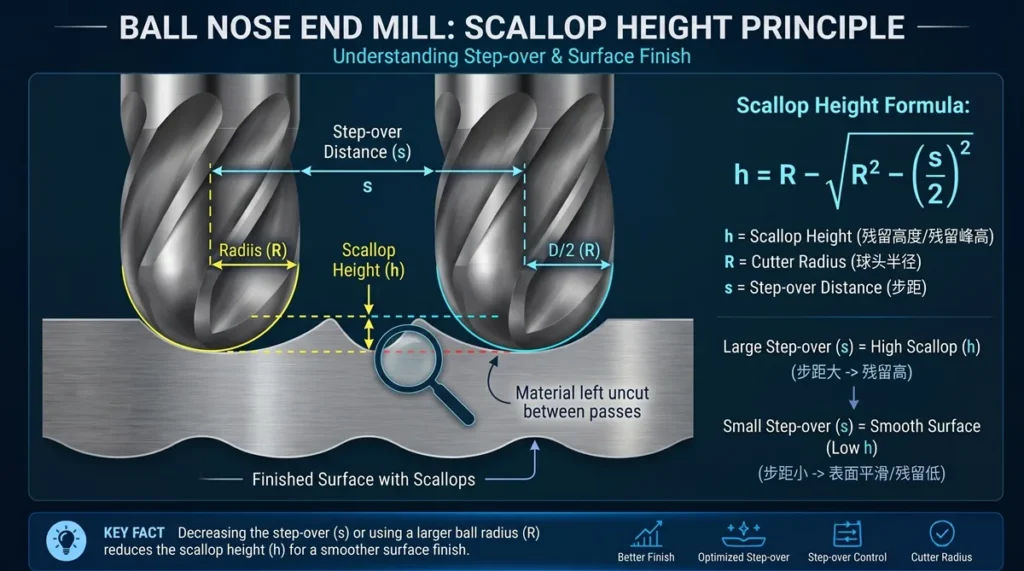
When a ball nose end mill machines a curved or flat surface through multiple overlapping passes, small ridges called scallops may remain between adjacent toolpaths.
These scallops are influenced by:
- Ball radius
- Adım mesafesi
- Surface curvature
- Toolpath direction
- Makine sertliği
- Tool wear and runout
For a simplified spherical tool geometry on a locally flat surface, the theoretical scallop height can be estimated using:
h = R − √(R² − (s/2)²)
Nerede?
- h = Theoretical scallop height
- R = Ball radius
- s = Stepover distance
For small stepovers, this can be approximated as:
h ≈ s² / (8R)
Reducing the stepover generally reduces theoretical scallop height, although it also increases machining time.
How Can You Improve Ball Nose Milling Performance?
Consider the following practices:
- Select the appropriate ball radius for the required surface geometry.
- Calculate the effective cutting diameter when machining with a shallow axial depth of cut.
- Use a suitable stepover based on the required surface finish.
- Consider tool inclination when the machining setup allows it.
- Check tool overhang and machine rigidity.
- Follow the cutting parameters recommended by the tool manufacturer.
For more detailed guidance, see the Ball Nose Milling Strategy Guide from Harvey Performance.
7. Bull Nose vs Ball Nose vs Square End Mill
Besides bull nose and ball nose end mills, square end mills are another widely used option in CNC milling.
Each tool has a different cutting profile.
| Alet Tipi | Kesme Geometrisi | Başlıca Uygulama Alanları |
|---|---|---|
| Kare Freze | Flat bottom with sharp corners | Slots, flat-bottom pockets, and square shoulders |
| Boğa Burunlu Freze | Flat bottom with rounded corners | Pocketing, profiling, and radiused internal corners |
| Bilyalı Uçlu Freze | Fully rounded hemispherical tip | 3D contouring, curved surfaces, and mold finishing |
The choice depends on the required geometry:
- Use a square end mill for flat surfaces with sharp internal corners.
- Use a bull nose end mill for flat surfaces with rounded internal corners.
- Use a ball nose end mill for curved surfaces and complex 3D profiles.
8. How to Choose the Right End Mill for Your Application
Selecting the right end mill requires more than comparing the cutting tip shape.
Consider the following factors before choosing a tool.
8.1 Workpiece Geometry
Start with the geometry of the part.
Determine whether the machining operation requires a flat bottom, sharp internal corner, radiused transition, or complex curved surface.
This is the most important factor when choosing between square, bull nose, and ball nose end mills.
8.2 Cutting Diameter and Corner Radius
Select a cutting diameter that matches the feature size and machining requirements.
For bull nose end mills, check that the corner radius matches the required internal radius.
For ball nose end mills, confirm that the ball radius is suitable for the required surface profile.
8.3 Number of Flutes
The number of flutes influences chip space, tool rigidity, and the cutting conditions that can be applied.
Two-flute tools generally provide more flute space for chip evacuation, while tools with more flutes may provide additional cutting edges and support different machining strategies.
The appropriate flute count depends on the workpiece material and machining operation.
8.4 Tool Length and Overhang
Longer tools can reach deeper or more difficult features, but excessive overhang can increase deflection and vibration.
Choose the shortest practical tool length that provides sufficient machining access.
8.5 Workpiece Material and Coating
The workpiece material affects carbide grade selection, cutting speed, feed rate, and coating requirements.
Different coatings may be suitable for different materials and machining conditions.
Always check the tool manufacturer’s recommendations when selecting a carbide end mill for steel, stainless steel, aluminum, or hardened materials.
For additional guidance, see our Karbür Uçlu Freze Seçim Kılavuzu.
9. Frequently Asked Questions
Is a Bull Nose End Mill the Same as a Corner Radius End Mill?
Yes. Bull nose end mills are commonly referred to as corner radius end mills.
Both terms describe an end mill with a flat cutting face and rounded cutting corners.
Can a Bull Nose End Mill Replace a Ball Nose End Mill?
Not in every application.
A bull nose end mill is suitable for flat-bottom features with rounded internal corners, while a ball nose end mill is designed for fully rounded profiles and complex 3D surfaces.
The correct tool depends on the required workpiece geometry.
Which Is Better for 3D Contouring: Bull Nose or Ball Nose?
A ball nose end mill is generally the preferred choice for complex 3D contouring because its hemispherical cutting tip can follow curved surfaces through suitable CAM toolpaths.
Bull nose end mills are more suitable when the geometry includes flat areas and defined corner radii.
Which End Mill Is Better for Flat-Bottom Pockets?
A bull nose end mill is suitable when the pocket floor requires rounded internal corners.
If the design requires sharp internal corners, a square end mill is generally more appropriate.
Does a Ball Nose End Mill Have a Flat Bottom?
No. A standard ball nose end mill has a hemispherical cutting tip rather than a flat cutting face.
Its radius is equal to half the cutting diameter.
Is a Ball Mill the Same as a Ball Nose End Mill?
No. A ball mill is a grinding machine used for processes such as powder grinding and material mixing.
A ball nose end mill is a rotary cutting tool used in CNC milling to machine curved surfaces and complex 3D profiles.
They are different types of equipment and should not be confused.
Does a Smaller Stepover Improve Ball Nose Surface Finish?
Generally, yes. A smaller stepover reduces the theoretical scallop height left between adjacent toolpaths.
However, it also increases machining time, so the appropriate stepover should balance surface finish, productivity, tool diameter, and machining conditions.
10. Need Help Choosing a Bull Nose or Ball Nose End Mill?
Choosing the right end mill geometry is important for achieving the required machining accuracy, surface finish, and productivity.
ONMY offers solid carbide bull nose and ball nose end mill options for different CNC milling applications.
Whether you are machining flat-bottom pockets, radiused corners, mold cavities, or complex 3D surfaces, selecting the correct tool geometry is an important step toward achieving consistent machining results.
When requesting a recommendation or quotation, please provide:
- İş parçası malzemesi ve sertliği
- Required cutting diameter (D)
- Corner radius or ball radius (R)
- Flüt sayısı
- Cutting length and overall length
- Machining operation and application
- Required coating, if applicable
Explore our product ranges:
Contact ONMY to discuss your CNC milling requirements and request a suitable end mill solution.