Fraises à queue en carbure monobloc à 4 dents
Find four-flute end mills with square or corner radius cutting ends. Compare 4E and 4R geometries across eight carbide tool series, then select a family by workpiece material, tool dimensions and length.
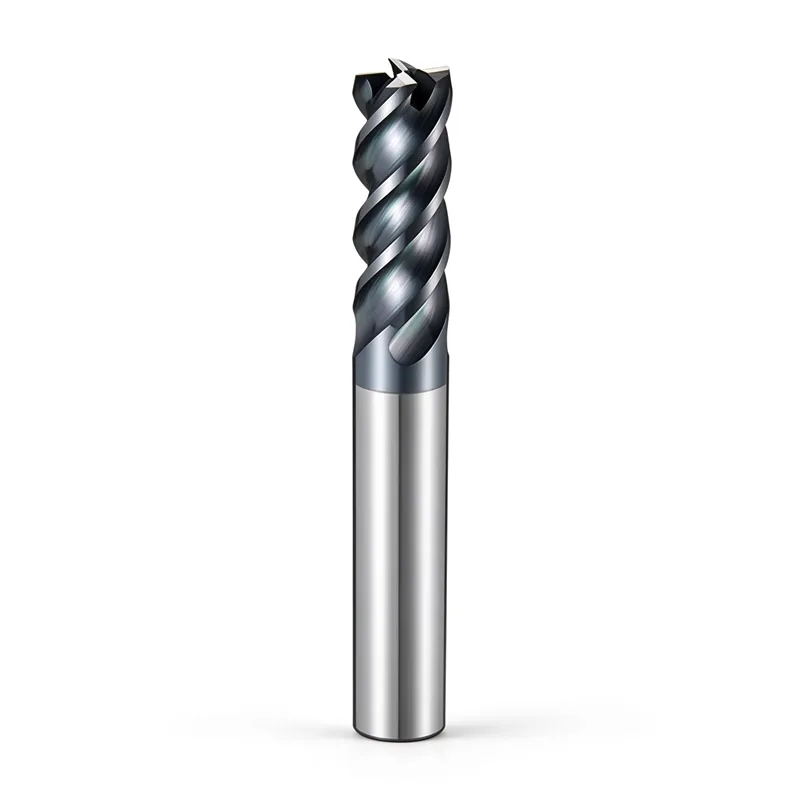
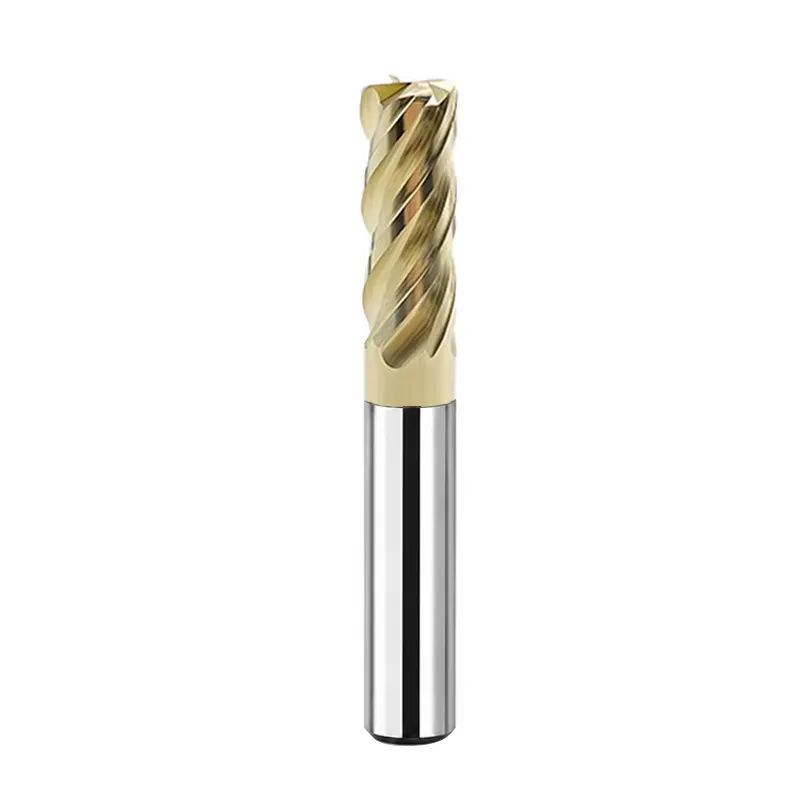
1 / 2 · 4E Square End Mill
4E Square or 4R Corner Radius?
Choose the cutting-end geometry first. Four-flute cutters in the same product series can have different corner shapes for different part features.
4E — 4 Flute Square End Mills
A flat cutting end for flat-bottom features, shoulder milling, side walls and selected shallow slots. Choose the tool dimensions for your material, cut depth and machine setup.
Voir les fraises à bout carré →4R — 4 Flute Corner Radius End Mills
A flat end with a defined corner radius R. Consider this shape when the part allows a radius and cutting-corner strength matters in side milling or semi-finishing.
Voir les fraises à bout arrondi →When Should You Choose a 4-Flute End Mill?
Four-flute tools are a common choice for controlled cutting in steel and other engineering materials. The best option depends on the tool geometry and machining conditions.
Side Milling & Finishing
Four cutting edges can support productive side milling and finishing when chip evacuation, feed and tool engagement are suitable.
Corner Shape Matters
Choose 4E for square features, or 4R where a specified corner radius is acceptable or required.
Check Chip Space
Full-width slots, gummy materials or deep cuts may need different flute counts or geometry. More flutes alone do not guarantee better results.
Explore 4 Flute End Mill Families
Browse eight series in 4E square and 4R corner radius shapes. Standard, long-shank and extra-long-shank versions are grouped under each family.
16 tool families shown
HMQ-4E
Economical options for general steel and selected aluminum milling; review chip evacuation for the operation.
HMQ-4R
Economical options for general steel and selected aluminum milling; review chip evacuation for the operation.
HMP-4E
Higher-performance series for steel and stainless steel machining.
HMP-4R
Higher-performance series for steel and stainless steel machining.
HMM-4E
General-purpose series for carbon steel, alloy steel, stainless steel, cast iron and hardened steel below HRC 40.
HMM-4R
General-purpose series for carbon steel, alloy steel, stainless steel, cast iron and hardened steel below HRC 40.
HMT-4E
Series positioned for efficient machining of stainless steel and titanium alloys.
HMT-4R
Series positioned for efficient machining of stainless steel and titanium alloys.
HMV-4E
Series positioned for efficient steel and stainless steel machining.
HMV-4R
Series positioned for efficient steel and stainless steel machining.
HMH-4E
High-speed series for high-hardness machining applications; confirm hardness and cutting conditions.
HMH-4R
High-speed series for high-hardness machining applications; confirm hardness and cutting conditions.
HMS-4E
Series for high-temperature alloys and titanium alloys; review the workpiece grade and conditions.
HMS-4R
Series for high-temperature alloys and titanium alloys; review the workpiece grade and conditions.
HMX-4E
Series positioned for super-high-hardness applications; confirm the hardness range and tool configuration.
HMX-4R
Series positioned for super-high-hardness applications; confirm the hardness range and tool configuration.
Choose a 4 Flute Series by Material
Start with the workpiece material and machining conditions. Each series has a different intended range; confirm diameter, coating and cutting conditions for the selected model.
HMQ is an economical general option; HMP and HMV target steel machining. HMM covers carbon and alloy steel, stainless steel, cast iron and hardened steel below HRC 40.
HMP, HMM and HMV include stainless steel applications; HMT targets efficient stainless and titanium alloy machining, while HMS targets titanium and high-temperature alloys.
Use the actual workpiece hardness to distinguish the HMM general-purpose range below HRC 40 from dedicated high-hardness HMH and super-high-hardness HMX applications.
HMS is intended for high-temperature and titanium alloys. HMQ is a catalogued steel/aluminum general option; for aluminum slotting and demanding chip evacuation, compare aluminum-specific tools first.
Match the Tool to the Milling Operation
Once the four-flute structure is selected, use the required part geometry and cutter engagement to narrow the choice between 4E and 4R.
Fraisage latéral et profilage
Both 4E and 4R can be candidates. Compare tool reach, workpiece material, radial engagement and the permitted corner geometry.
4E / 4RFlat-Bottom Pockets & Shoulders
Choose 4E where the feature requires a square tool corner and flat-bottom geometry. Verify entry strategy and chip clearance.
4E SquareSemi-Finishing with a Corner Radius
Choose 4R when the part profile allows the specified corner radius. Check the corner radius against minimum part clearance.
4R Corner Radius4 Flute End Mill Dimensions: D, d, H, L & R
Use the dimension symbols below to confirm the cutting diameter, shank fit, cutting length, overall length and — for 4R only — the corner radius.
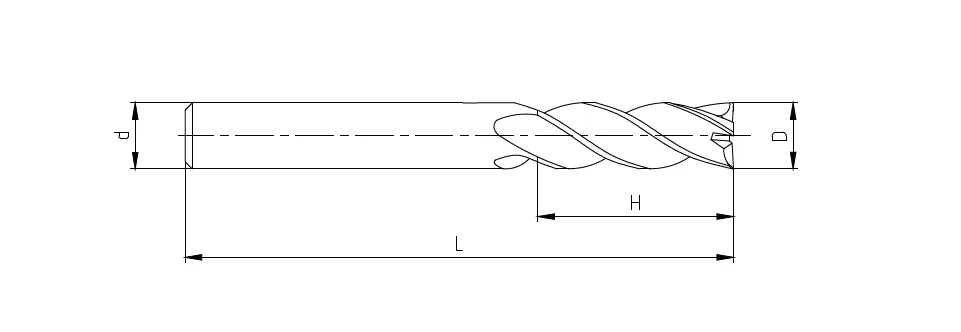
The two end shapes require different drawings. The R dimension applies to corner-radius tools only.
How to Read Cutter Dimensions
Length configurations: 4E / 4EL / 4EX and 4R / 4RL / 4RX. EL, EX, RL and RX denote longer-shank configurations in the current series. Verify actual H and L for each order number rather than assuming longer cutting edges.
Request 4 Flute End Mill Pricing & Specifications
Share the product series, tool geometry and required dimensions so a suitable 4E or 4R cutter can be reviewed.
- Product family or order number (4E or 4R)
- Diamètre de coupe D, diamètre de la tige d et longueur de coupe H
- Overall length L and corner radius R where applicable
- Workpiece material, hardness, machining operation and quantity
Demander les tarifs et les caractéristiques techniques
Veuillez indiquer le modèle, l'application et la quantité, si vous disposez de ces informations.