ワンストップ金属加工ソリューション

Comprehensive Classification of Thread Types and Selection Guide

Comprehensive Classification of Thread Types and Selection Guide

Screw threads (also called screw threads or fastener threads) are helical ridges on cylindrical surfaces that convert rotational motion into linear motion or force. They are essential in fasteners (bolts, screws, nuts), power transmission (leadscrews, jacks), pipe sealing, and precision mechanisms.

1. Key Terminology

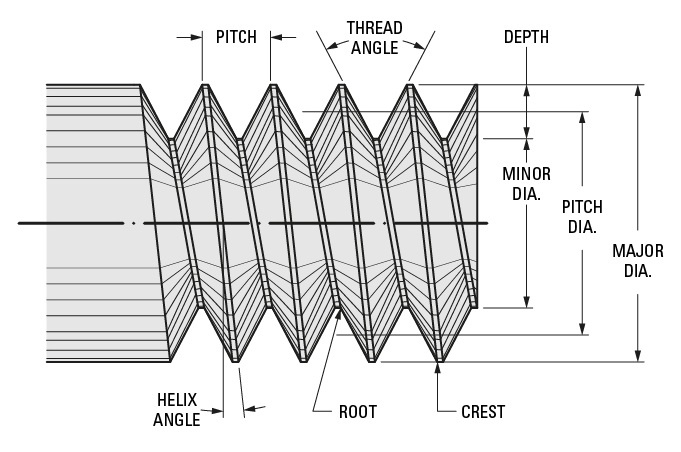
Understanding geometry is essential before classifying threads:

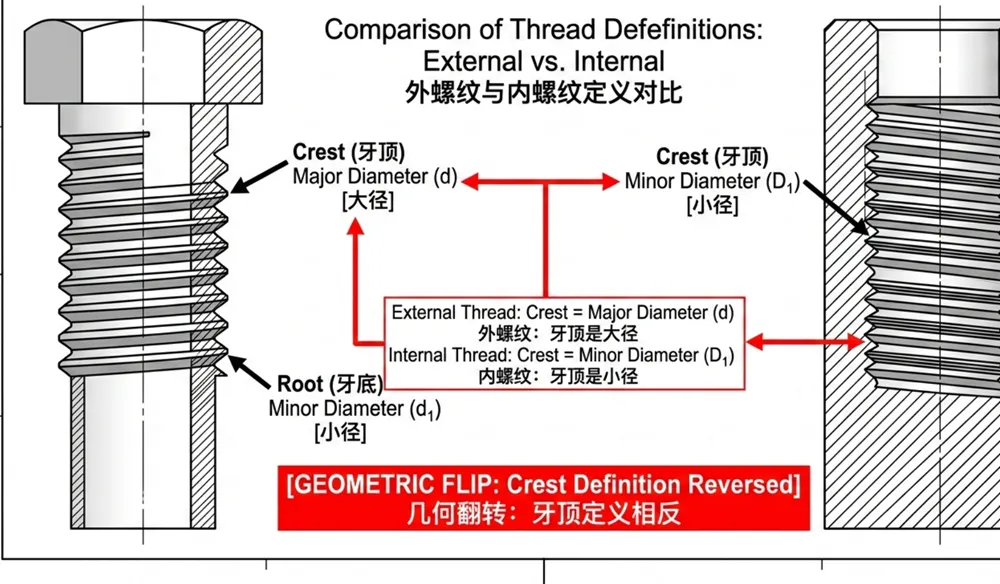
  • Major diameter: Largest diameter (crests on external threads; roots on internal).
  • Minor diameter: Smallest diameter (roots on external; crests on internal).
  • Pitch diameter: Theoretical diameter where thread width equals groove width.
  • ピッチ: Axial distance between adjacent thread crests (mm in metric; threads per inch/TPI in imperial).
  • Lead: Axial advance per revolution (equals pitch for single-start threads).
  • Flank angle: Angle between thread flank and axis perpendicular (e.g., 60° for most V-threads).
  • Crest/Root: Outer/inner parts of the スレッドプロファイル.
  • Handedness: Right-hand (RH, standard; clockwise tightens) or left-hand (LH).
  • テーパー: Parallel (straight) or tapered (conical for sealing).
Understanding Different Types of Threads - Chiggo
Screw Threads for Beginners: From Terms to Types

2. Comprehensive Classification

By Function

  • Fastening/Mounting Threads: For joining parts (bolts, screws, nuts). Most common triangular/V-profile.
  • Power/Transmission Threads: Convert torque to linear force/motion (leadscrews, vises, jacks). Trapezoidal, square, or buttress profiles.
  • Pipe/Sealing Threads: For fluid/gas connections. Often tapered for interference seal.
  • Special Threads: Wood screws, self-tapping, knuckle (rounded for durability), multi-start (faster advance).

By Thread Form/Profile (Cross-Section)

Different Types of Threads
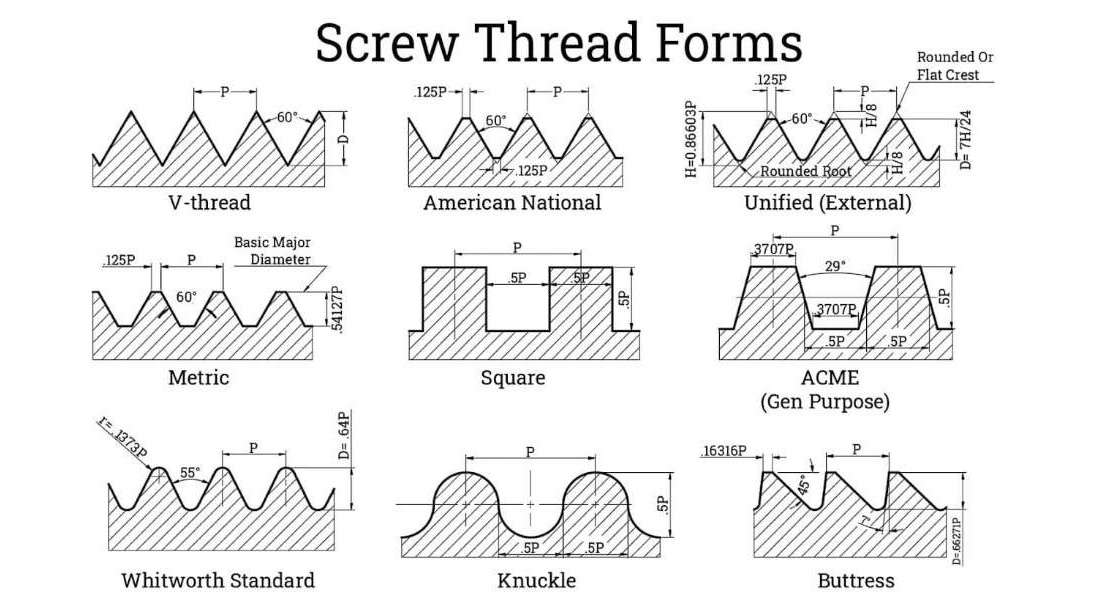
  • Triangular/V-Thread (60° or 55° flank angle): Most common for fastening. Includes sharp-V, truncated (practical), ISO Metric, Unified, Whitworth. High strength in tension but higher friction.
  • Square Thread: Square profile; lowest friction/highest efficiency for power transmission. Difficult and expensive to manufacture; weaker root.
  • Acme/Trapezoidal Thread (29°–30° flank angle): Flat crests/roots; easier to machine than square. Good for power screws; balanced efficiency and strength.
  • Buttress Thread (asymmetric, often 45° one side): High load capacity in one direction; efficient like square but stronger shear. Used in presses/vices.
  • Round/Knuckle Thread: Rounded profile; resistant to dirt/corrosion. Used in harsh environments (e.g., railroads, couplings).
  • Others: Worm (helical gear-like), saw-tooth variants.

By Standardization System and Measurement

  • ISO Metric (M): Global standard (60° V-profile). Coarse (default) or fine pitches. Designation: M10×1.5 (diameter × pitch). Standards: ISO 261/724.
  • Unified Thread Standard (UTS – Inch): US/Canada dominant (60°). UNC (coarse), UNF (fine), UNEF (extra fine), UNS (special). E.g., 1/2-13 UNC (diameter-TPI). Standards: ANSI/ASME B1.1.
  • Whitworth (British): 55° rounded. BSW (coarse), BSF (fine), BSP (pipe). Largely historical but still in UK/Commonwealth.
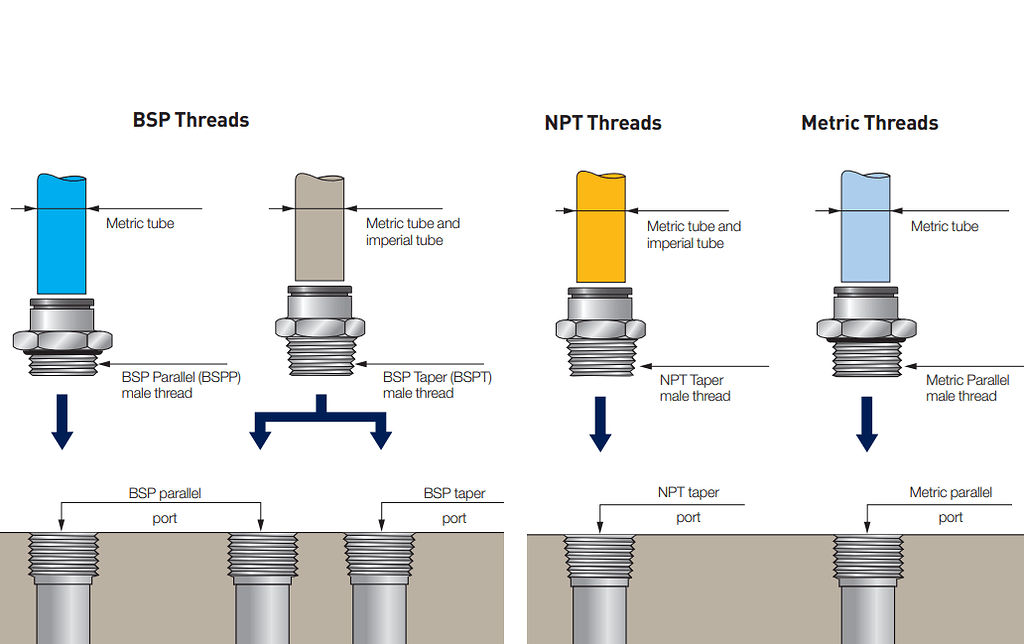
  • Pipe Threads:
    • NPT/NPTF (US tapered, 60°; self-sealing with tape).
    • BSPP/G (parallel, 55°; needs washer/sealant).
    • BSPT/R (tapered, 55°).
  • Power/Transmission Series: Trapezoidal (Tr/DIN 103), Acme (ASME), Square, Buttress.
  • Others: PG (conduit), BA (small instruments), UNJ/MJ (aerospace with root radius).

When choosing thread turning tools, you can select from our extensive product range.

Thread Types: NPT, BSPT, and BSPP

By Pitch Series

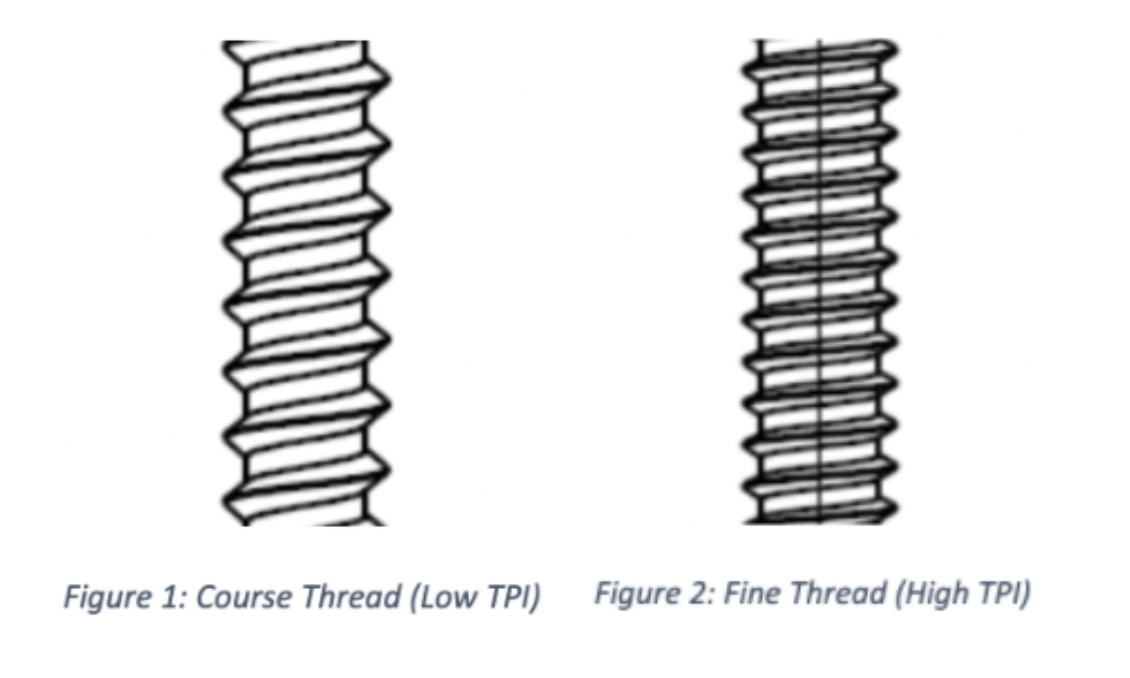
  • 粗目: Larger pitch/fewer TPI. Faster assembly, better stripping resistance, easier in brittle materials or with plating.
  • Fine/Extra Fine: Smaller pitch/more TPI. Higher tensile strength, better vibration resistance, finer adjustment, stronger in thin walls.
Fine Thread vs Coarse Thread: Stenght + Usage | SFS USA

us.sfs.com

By Other Criteria

  • Handedness: RH (default) vs. LH (anti-loosening in rotating assemblies).
  • Starts: Single (standard) vs. multi-start (faster linear advance, lower self-locking).
  • Taper vs. Parallel: Taper for sealing; parallel for general use.
  • Tolerance/Fit Classes (Unified): 1A/1B (loose), 2A/2B (general purpose, ~90% use), 3A/3B (precision/tight). Metric uses tolerance grades (e.g., 6g/6H).

3. Thread Fit, Strength & Manufacturing

  • Classes of Fit: Control clearance/tightness. 2A/2B balances assembly and strength; 3A/3B for critical applications. Allowance often added for plating.
  • 強さ: Bolt should fail in tension before threads strip. Engagement length ~1× diameter (steel). Rolled threads (stronger, smoother) preferred over cut.
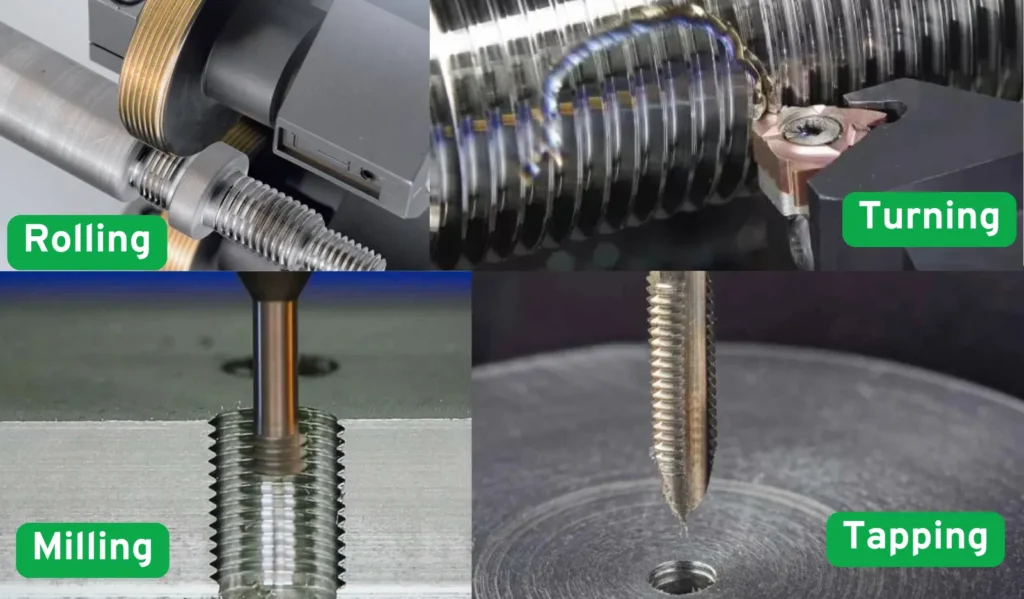
  • 製造業: Cutting vs. rolling; affects cost and fatigue life.

4. Selection Guide

Choose based on these step-by-step factors:

Region/Compatibility — Metric (M) worldwide (except US/UK legacy). Unified (UNC/UNF) in North America. Whitworth/BSP in UK/Commonwealth. Match mating parts to avoid incompatibility.

一次申請:

  • General Fastening: ISO Metric coarse or UNC. Use fine (MF/UNF) for vibration, thin materials, or precision.
  • Pipe/Sealing: NPT (US, tapered, sealant optional with NPTF). BSPT (tapered, Europe/Asia). BSPP (parallel + O-ring/washer). Avoid mixing.
  • Power Transmission/Motion (Clamps, Leadscrews, Vises):
Thread Type効率性Strength/ShearManufacturability最適Drawbacks
Standard (UNC/UNF)ミディアムHigh (shaft)ExcellentGeneral clampsSlower actuation
Acme/Trapezoidal高いグッドグッドVises, actuatorsModerate cost
Square最高Lower rootPoorPrecision leadscrewsHard to machine
Buttress高いHighest (one way)グッドUnidirectional pressesOne-direction only

Load, Vibration & Environment:

  • High vibration: Fine threads or locking features.
  • Heavy/unidirectional load: Buttress.
  • High efficiency/low friction: Square or multi-start.
  • Harsh/dirty: Knuckle/round.
  • Self-locking needed: Coarse or standard V (avoid multi-start).

Assembly & Performance:

  • Speed/ease: Coarse threads (fewer turns).
  • Strength/preload: Fine threads.
  • Thin walls/brittle materials: Coarse.
  • Plating/coatings: Allow extra clearance (Class 2A).

Other Considerations:

  • Cost: Standard V-threads cheapest.
  • Handedness: LH for specific anti-loosening (e.g., bike pedals, gas cylinders).
  • Multi-start: For faster travel with low friction.
  • Safety/Critical: Use 3A/3B fit, UNJ/MJ profiles, verified engagement.
  • Identification Tip: Measure major diameter + pitch/TPI + flank angle (60° vs 55°). Use thread gauges or calipers.

Examples:

  • General bolt (Europe): M8×1.25 (coarse metric).
  • US fastener: 3/8-16 UNC.
  • Pipe (US): 1/2 NPT.
  • Leadscrew: Tr20×4 (trapezoidal) or 1″-5 Acme.

Practical Tips: Always match external/internal threads and standards. For new designs, prefer Metric ISO for global availability. Consult ASME B1.1 / ISO 261 tables for exact dimensions/tolerances. Use thread-locking compounds or washers for vibration. If unsure, test fit with Go/No-Go gauges.

This classification and guide cover the vast majority of industrial, automotive, plumbing, and machinery applications. For specialized aerospace, wood, or plastic threads, additional standards (e.g., UNJ, self-tapping) apply.

よくあるご質問

コメントを残す

メールアドレスが公開されることはありません。 が付いている欄は必須項目です

トップに戻る

今すぐ売上を急上昇させよう

あなたに必要なのは、CNC工具業界の真のベテランです。ONMYツーリングにお任せください。